
Why is the decision to have a baby changing in Mexico? What current demographics reveal about fertility, motherhood, and new families

For years, Mexico was one of the countries with the highest birth rates in Latin America. Having children at early ages was a natural part of life for millions of people, and large families were much more common than today.
But new generations began to transform that reality.
Today, Mexico has a lower birth rate than even the United States. While in 1996 the average was around 2.8 children per woman, today the figure is closer to 1.4. And although this trend reflects enormous social, economic, and cultural changes, it also reveals something much deeper: motherhood and fatherhood are no longer lived the way they were thirty years ago.
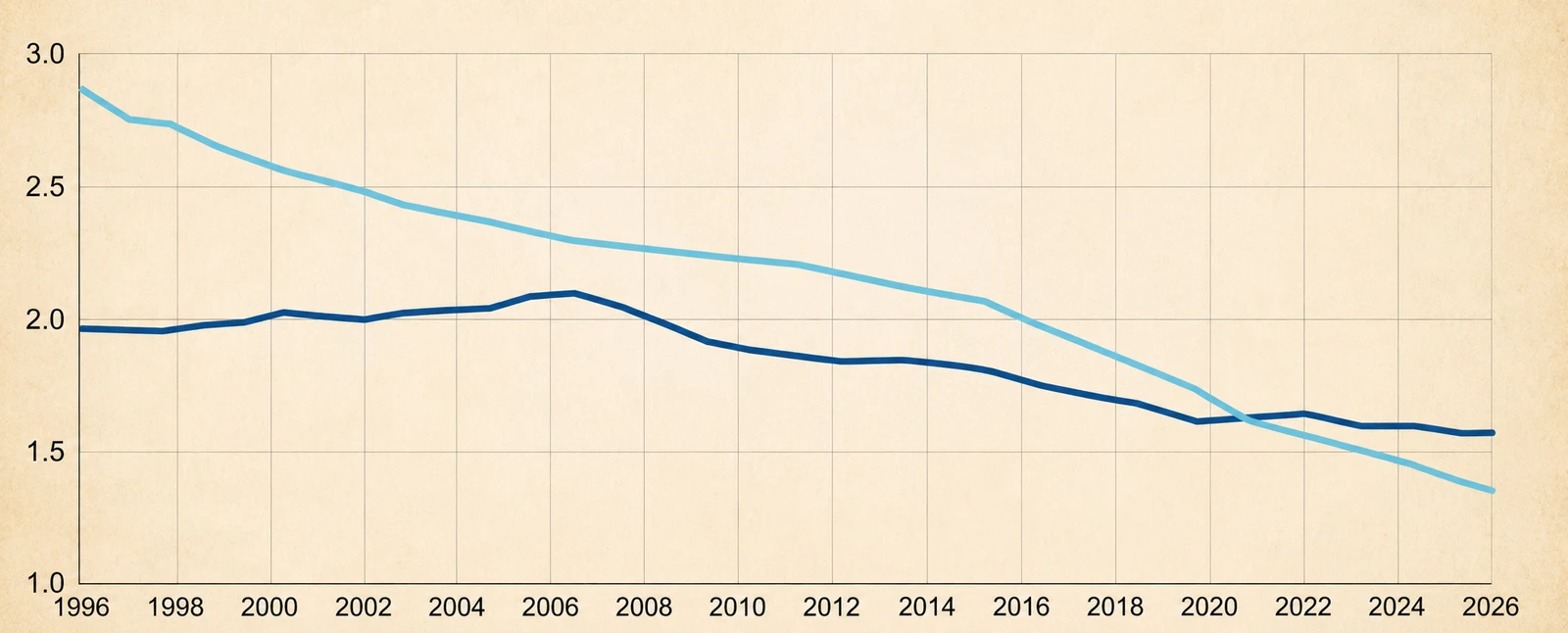
Evolution of the fertility rate in Mexico (1996-2024)
Today people seek to build a family from a place of awareness, planning, and the freedom to decide when to take that step.
And precisely because of this, reproductive medicine has become an increasingly important tool to walk with this new reality.
Motherhood no longer follows the same rules as before
Priorities changed. Today, many women decide to focus first on:
- Their professional growth
- Financial stability
- Personal development
- Studies
- Travel
- Emotional well-being
- Finding a stable relationship at the right moment
This means that the decision to have a baby usually comes later in life.
And far from being negative, this speaks to a much more conscious motherhood, planned and aligned with personal life projects.
However, while society evolved quickly, reproductive biology still operates under certain natural timelines. As years go by, ovarian reserve decreases and egg quality can be affected, especially after age 35.
That’s why, today more than ever, understanding fertility preventively has become essential.
The good news is that reproductive medicine has also evolved
A few decades ago, many people simply waited for pregnancy to happen naturally at some point. Today the story is different.
Modern assisted reproduction has made it possible to develop tools capable of studying fertility with much greater precision, understanding that every patient lives a completely different reality.
Today it is possible to analyze:
- Ovarian reserve
- Embryo quality
- Hormonal factors
- Genetic health
- Endometrial receptivity
- Male factors
- Metabolic alterations
- Age-related cell quality
This has completely changed the way fertility is approached. It’s no longer just about “keep trying.” Now it’s possible to identify with greater clarity what factors might be making pregnancy difficult and create personalized strategies for each case.
At Ingenes, we understand that modern fertility needs equally modern solutions. That’s why we work with high-complexity technology, advanced diagnostics, and personalized treatments that walk with patients with different reproductive needs, even in scenarios where possibilities once seemed much more limited.
Age no longer necessarily defines the whole story
One of the biggest social changes reflected by the decline in birth rates is that many women decide to seek pregnancy at later stages in life.
And although age does biologically influence fertility, today there are medical tools capable of expanding the reproductive possibilities of many patients.
Thanks to innovation in assisted reproduction, today it is possible to support cases related to:
- Low ovarian reserve
- Decreased egg quality
- Age-related infertility
- Implantation failures
- Complex male factors
- Hormonal alterations
- Reproductive processes that require precision diagnosis
Modern reproductive science has advanced enormously in recent years and continues evolving to respond to the real needs of new generations.
At Ingenes, this approach seeks to help more people get closer to the possibility of having a baby even when they face significant reproductive challenges.
Because today the conversation is no longer just “can I get pregnant?” but also “what tools exist to help me achieve it?”
New generations are also redefining what it means to start a family
The decline in children per woman also reflects an important transformation in the structure of households. Today we see families much more diverse than a few decades ago.
Today there are:
- Women who choose to become single moms by choice
- Same-sex couples building a family
- People who want to have only one child
- International patients seeking advanced reproductive options
- People who decide to preserve their fertility for the future
- Couples who want to postpone motherhood without giving it up
The traditional idea of family evolved. And reproductive medicine had to evolve too.
At Ingenes, we understand that there is no single correct way to build a family. Every story is different and every patient deserves personalized support that adapts to their needs, timing, and life goals.
Because the desire to have a baby doesn’t depend on statistics, traditional models, or social expectations. It depends on the personal decision to take that step.
Preserving fertility is becoming an intelligent and preventive decision
The current demographic trend also makes one thing clear: the next generations will likely continue postponing motherhood.
And faced with this new reality, fertility preservation has become a key tool.
Egg freezing allows preserving eggs at a stage where cell quality is usually more favorable, helping many women keep their reproductive possibilities open while they continue developing other aspects of their lives.
Today, many patients consider this alternative because they want to:
- Focus first on their professional career
- Wait for the right moment to start a family
- Have greater peace of mind about their reproductive future
- Protect their fertility before certain medical treatments
- Make reproductive decisions with more freedom and less biological pressure
At Ingenes, fertility preservation is part of a preventive approach that seeks to give patients more options to build their reproductive future according to their own timing.
Fertility and emotional well-being: an increasingly important conversation
Modern motherhood has also brought new emotional challenges. Many people feel pressure related to:
- Age
- The biological clock
- Social expectations
- Financial stability
- Complex reproductive processes
- Balance between professional and personal life
And when pregnancy takes time to arrive, emotions such as anxiety, frustration, or emotional exhaustion can appear.
That’s why fertility today needs a much more comprehensive approach.
At Ingenes, we understand that behind every treatment there is an important emotional story. That’s why we seek to walk with each patient with personalized, close care focused on both the medical side and well-being throughout the process.
Because building a family also means feeling accompanied.
A decline in birth rate doesn’t mean less desire to start a family
Although statistics show fewer births, that doesn’t mean people have stopped wanting to have children. What really changed is the way new generations live motherhood and fatherhood.
Today reproductive decisions tend to be made with more awareness, more information, and a much more personalized vision of the future.
And that’s precisely where reproductive medicine plays a fundamental role. Today’s technology allows many people to explore alternatives, better understand their fertility, and access tools that simply didn’t exist a few years ago.
Ingenes: walking with the new reality of fertility
Society changed. The way of building a family evolved. And assisted reproduction advanced to respond to the needs of this new generation.
Today, starting a family no longer depends solely on following the same path as previous generations. Now there are medical tools capable of personalizing treatments, studying fertility with precision, and helping more people get closer to the possibility of having a baby.
At Ingenes, we work with advanced technology, scientific innovation, and personalized care to walk with patients who want to better understand their fertility and explore the options available to build the family they imagine.
Because in a reality where motherhood and fatherhood are lived differently, knowing that alternatives exist can also completely change the story.