

Pause
the biological clock
Egg quality has its best biological moment. With egg freezing you preserve your fertility right there, so your life plan can set the timing.

Egg freezing is an advanced fertility preservation technique that ensures your ability to become a mom whenever you decide. We extract your eggs when their quality is optimal, vitrify them at -196°C, and keep them viable for years.
It's an increasingly chosen decision for women who want to take control of their fertility: to focus first on their career, wait for the right moment, or protect themselves from medical treatments that can affect their ovarian reserve.
- 0°C ultra-fast vitrification that preserves cell quality
- <0 years ideal age to preserve the best egg quality
- +0 years your eggs can stay viable without losing quality
- +0 years of Ingenes experience in assisted reproduction
Egg freezing: a smart, preventive decision
Egg freezing or vitrification is a procedure that extracts mature eggs from your ovaries and preserves them through ultra-fast cooling. This avoids the formation of ice crystals that could damage the cell and keeps your eggs in their most optimal state.
Vitrified eggs can be stored for years without losing their reproductive quality. When you decide it's time to become a mom, they are thawed, fertilized in the lab through In Vitro Fertilization, and transferred to your uterus.
It's an increasingly accessible and safe option, with success rates that have significantly increased thanks to advances in cryopreservation.

Your path is unique. So is your plan.
We design a protocol tailored to you after understanding your story and your previous tests. No generic diagnoses or protocols.
Three reasons to preserve your fertility today
The quality of your eggs decreases over time, but the quality you have today can be preserved for tomorrow.
-
Freedom to decide
Your life plan doesn't have to adapt to your biological clock. You can focus on your career, wait for the right partner, or simply take the time you need, knowing your eggs are waiting in their best state.
-
Quality preserved
Egg quantity and quality decrease, especially after age 35. Freezing them before that age ensures that when you use them, they have the same reproductive potential they had on the day of extraction.
-
Medical peace of mind
For women with medical diagnoses that may affect fertility (cancer, autoimmune diseases, endometriosis), preserving eggs before starting treatment is an essential measure to protect future motherhood.
Who can benefit from egg freezing?
Fertility preservation is not just for an ideal woman. Every case is different and every decision is valid.
- Life plan
By personal choice
Women who want to postpone motherhood to focus on other aspects of their life, without pressure from the biological clock.
- Professional or academic growth
- Waiting for the right moment or partner
- Greater freedom to make reproductive decisions
- Under 35: ideal age to preserve
- Medical reason
For health reasons
Women with diagnoses or treatments that may affect their ovarian reserve or egg quality.
- Cancer diagnosis (before chemo or radiotherapy)
- Autoimmune or genetic diseases
- Endometriosis or ovarian issues
- Surgeries that compromise ovarian reserve
The freezing process, step by step
Our preservation process follows strict laboratory standards and is accompanied by a medical team specialized in assisted reproduction at every stage.
- Ovarian stimulation: with supervised hormonal medication we encourage the maturation of multiple eggs in a single cycle.
- Egg retrieval: extraction of mature eggs through a simple, minimally invasive procedure without significant pain.
- Vitrification: ultra-fast freezing at -196°C that preserves cell viability for years.
- Storage: your eggs are stored in our nitrogen bank under controlled conditions, for an initial period of 1 year (extendable).
- Detailed report: you receive a complete report with the quantity and quality of your preserved eggs.
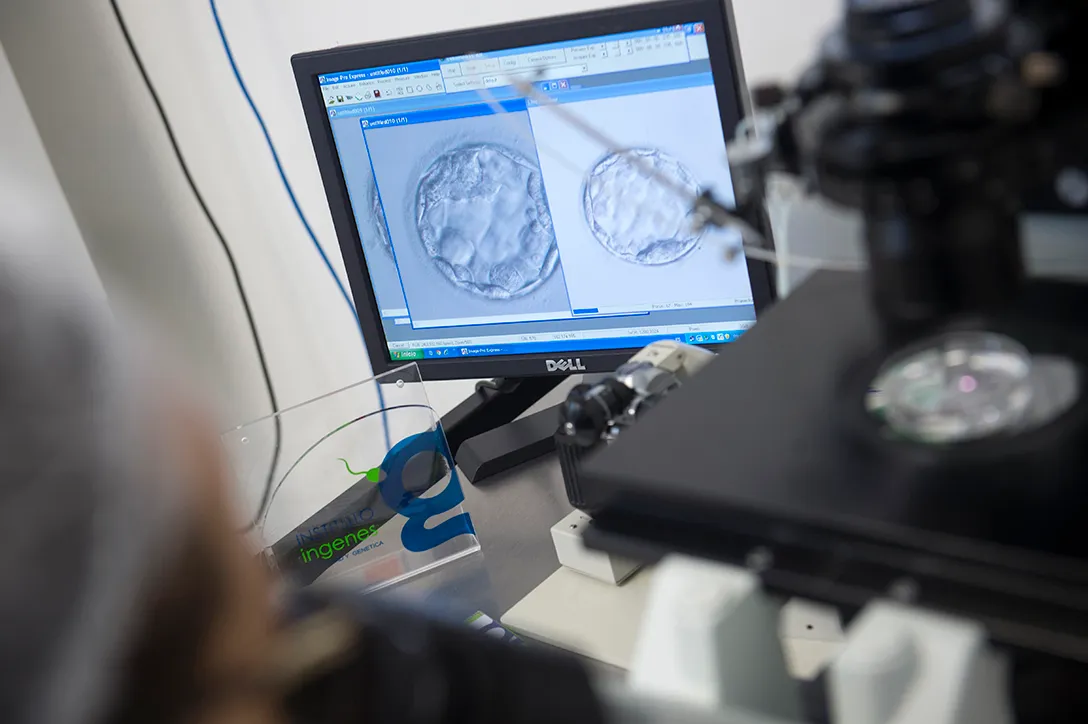
What happens the day you decide to become a mom?
Your preserved eggs are the first piece of a comprehensive process. We walk with you every step, from thawing to birth.
-
1. Thawing and fertilization
Your eggs are carefully thawed in the lab and fertilized through In Vitro Fertilization (IVF) with selected sperm, in a controlled environment that optimizes success chances.
-
2. Embryo development and selection
Embryos are monitored during their development. We select the healthiest and most viable for transfer, increasing pregnancy probability.
-
3. Transfer and pregnancy
We transfer the embryos to your uterus in a simple, painless procedure. We accompany you throughout your pregnancy until the day you bring your baby home.
Frequently asked questions about egg freezing
What's the ideal age to freeze eggs?
Before age 35, ideally between 25 and 34. At this age egg quality is optimal, which translates into higher success rates when you decide to use them. After 35 the procedure is still viable, but egg quantity and quality decreases, so it's best to act as soon as possible.
How long do frozen eggs last?
Vitrified eggs can stay viable for many years (over 10 without issues) without losing quality, because at -196°C all biological activity stops. At Ingenes the initial storage is for 1 year, with the possibility of renewing the storage time according to your needs.
Does egg retrieval hurt?
Egg retrieval is a simple, minimally invasive procedure without significant pain. It's done under sedation, takes between 20 and 30 minutes, and you can go home the same day. Recovery is very quick.
How many eggs can be frozen in a single cycle?
It depends on your ovarian reserve, age, and response to hormonal stimulation. On average, 10 to 15 mature eggs are obtained per cycle. In your first consultation we evaluate your reserve with hormonal studies and ultrasounds to give you a realistic estimate of your case.
What if I need more than one cycle?
Some patients choose to do two or more stimulation cycles to preserve more eggs and increase future success probabilities. Your specialist recommends how many cycles you need based on your ovarian reserve and your motherhood plan.
Does freezing affect egg quality?
No. Vitrification is an ultra-fast freezing technique that avoids the formation of ice crystals, the main cause of cell damage in slow freezing methods. Vitrified eggs maintain practically the same viability as fresh eggs at the time of use.
What are the success rates of IVF with preserved eggs?
Success rates depend on the age at which the eggs were preserved (not your current age when using them) and the quantity available. If you froze before age 35, probabilities are comparable to an IVF cycle with fresh eggs. Your specialist explains the real probabilities of your case.
Does egg freezing have risks?
The procedure is very safe. The main risks are mild: possible temporary discomfort from hormonal stimulation and, in rare cases, Ovarian Hyperstimulation Syndrome. With proper medical monitoring, which at Ingenes we do at every stage, both are avoidable.
Your fertility, your timing
Book your first consultation to evaluate your ovarian reserve, learn if preservation is the best option for you, and design the plan that best fits your story.
Contact us