

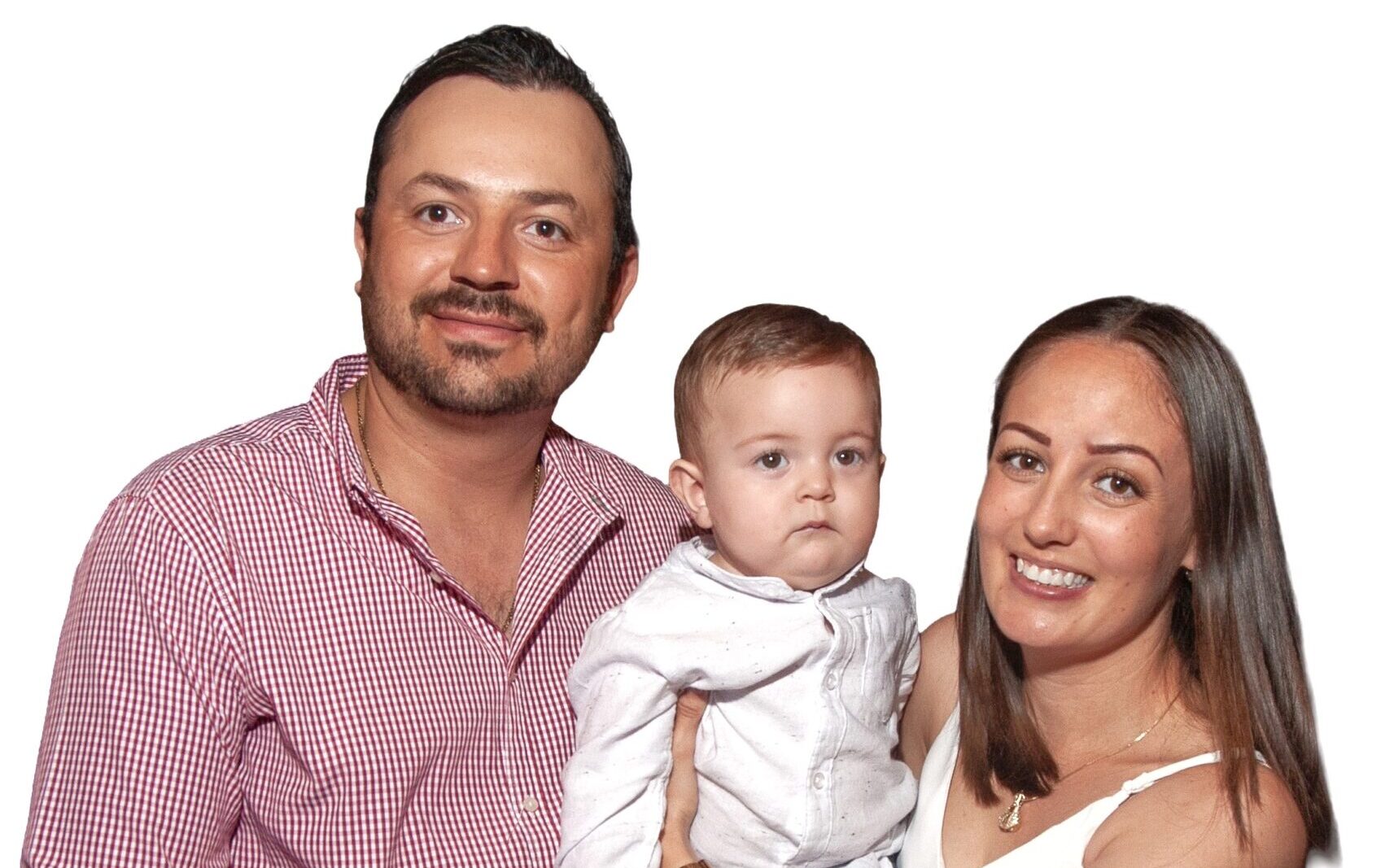
Infertility and neonatal loss are silent journeys that transform everyone who walks them. They are not just medical diagnoses; they are emotional trials that challenge the very foundation of a relationship. Yet, amidst the uncertainty, there are stories that remind us that persistence, guided by science, can bring light back into a home.
This is the story of Brenda and Mario, a couple who knew the deepest pain after losing their first son, but who refused to stop dreaming. Their testimony is a journey from grief and poor medical care to finding a team that saw not just a clinical file, but two human beings searching for what sometimes seems like a miracle.
Grief and the Courage to Start Again
Brenda and Mario’s path to parenthood didn’t begin in a fertility clinic, but in a grieving process that marked their lives 11 years ago. The couple lived through one of the most devastating experiences for any parent: the passing of their firstborn, at just 23 days old.
Perinatal and neonatal grief leaves invisible scars. The fear of history repeating itself paralyzes many couples, stopping them from seeking help for years. The fact that Brenda and Mario decided, after a time of healing, to “revisit the idea of starting a family” is a testament to unbreakable resilience. Deciding to try again is the first act of love toward the child who has not yet arrived.
However, a patient’s bravery must be met with medical excellence. Unfortunately, the first step they took outside their home didn’t find the solid ground they needed.
When “Help” Becomes an Obstacle: The Previous Experience
Following a friend’s recommendation, Brenda and Mario visited a conventional fertility clinic. This moment is critical: couples arrive vulnerable, placing absolute trust in the medical staff seeing to their case.
Far from bringing them peace, the experience at this first clinic added more anguish to their process. Mario recounts a situation that highlights the lack of personalized protocols in certain sectors of reproductive medicine:
“We received very poor treatment there, a terrible experience. They gave me 4 antibiotics at once because I supposedly had an infection. It triggered several complications.”
The Impact of a Wrong Diagnosis
Mario’s case illustrates a grave error: imprecise diagnosis and excessive medication. In reproductive health, the male factor is responsible for 40-50% of infertility cases. Treating a supposed infection with such an aggressive load of antibiotics without clear justification not only affects the patient’s general health but can deteriorate sperm quality (such as DNA fragmentation or motility), further complicating the chances of conception.
Beyond the physical damage, there was a communication barrier:
“The doctor answered our questions in a very technical way, but we didn’t understand him.”
Assisted Reproduction is a complex science, full of terms like blastocyst, fertilization, stimulation, or endometrium. It is the specialist’s responsibility to translate that complexity into human language. When a doctor hides behind technical jargon, it creates a gap of anxiety for the couple. Brenda and Mario felt alienated from their own process, not understanding why, after so much medication, the result remained negative.
Restoring Confidence: Finding Ingenes León
After the disappointment and health complications from the poor treatment, the couple reached a breaking point. Keep trying or give up? The answer came through research. Mario, determined not to repeat the bad experience, turned to digital information to find a solid alternative.
“It didn’t work at that clinic, but luckily Ingenes was there. I searched for ‘Ingenes León’ and saw over 200 reviews, and none of them were bad. That gave me confidence.”
In modern medicine, reputation is built on real stories. Seeing that hundreds of people had achieved their dream at Ingenes León allowed Mario and Brenda to take a leap of faith. Upon arriving at the branch, the contrast was immediate. They didn’t find cold treatment or generic prescriptions.
They found Dr. Fernanda.
The initial diagnosis at Ingenes was the real starting point. Unlike their previous experience, here the couple was evaluated holistically, understanding not just their biological factors, but their emotional history and the loss of Juan Pablo.
“We fell into Dr. Fernanda’s hands and had very warm support throughout the entire process.”
The Reality of IVF: Managing Expectations and Emotions
The indicated treatment was In Vitro Fertilization (IVF), the method with the highest complexity and success rates. The process involves stimulating Brenda’s ovaries, retrieving eggs, and fertilization in the lab to create embryos.
However, biology isn’t always predictable. Despite having good quality embryos, the first transfer attempt did not result in a pregnancy.
“After the embryos were made, the first two didn’t stick. I got upset, but the doctor told me to take everything calmly.”
Mario’s frustration at this point is a completely natural reaction. After years of searching, a previous loss, and a bad medical experience, a negative result feels like a devastating failure.
This is where medical ethics and human quality play their most important role. A committed team doesn’t abandon the patient when the result is negative; on the contrary, they double down on support. Dr. Fernanda acted as the pillar of strength the couple needed, explaining that assisted reproduction is often a cumulative process.
At Ingenes, programs are designed under a Multi-Cycle model, meaning more than one attempt is contemplated to achieve the goal. The doctor asked for calm and trust, adjusting protocols for the next attempt. It wasn’t about luck; it was about scientific perseverance.
The Miracle of Life and High-Risk Support
On the next attempt, after adjusting the strategy and preparing both body and mind again, the awaited news arrived: Brenda was pregnant.
But for a couple who lost a child at 23 days old, a positive pregnancy test isn’t the end of anxiety—it’s the beginning of a stage of extreme vigilance. Mario clearly mentions the challenges they faced:
“The process of making the eggs, the medication, the danger of miscarriage, everything… it was handled very well and they were with us always.”
The mention of “danger of miscarriage” indicates that Máximo’s pregnancy was not simple. There were threats, fears, and critical moments. The difference lies in the fact that Brenda and Mario were never alone.
“They always attended to us, even in the early hours of the morning.”
24/7 availability is vital in high-value, high-risk pregnancies. Knowing they can call their medical team at 3:00 a.m. for a strange symptom provides mental peace of mind that positively impacts gestation. Ingenes accompanied the family not only until achieving the positive result but “until the delivery,” ensuring Máximo arrived into the world in the best possible conditions.
And so, after the storm, Máximo was born. A healthy baby who arrived to heal wounds and prove that the right diagnosis and humane treatment can defeat infertility.
A Growing Family: The Vision for the Future
Brenda and Mario’s story doesn’t end with Máximo’s birth. Thanks to embryo freezing technology, the couple has secured not just their present, but their family’s future.
“Right now we have 7 frozen embryos, so that at a certain moment, we can go for the little brother or sister.”
During the IVF cycle, multiple viable embryos were developed. Once Máximo’s pregnancy was achieved, the remaining embryos were cryopreserved (frozen) in the Ingenes bank.
This radically changes the landscape for Brenda. If they decide to give Máximo a sibling, they won’t have to go through ovarian stimulation or egg retrieval again. The road is paved; the embryos are waiting, suspended in time with the same quality as day one, ready for when the family decides to grow. Having 7 embryos means having 7 opportunities for life safeguarded, a “reserve of hope” that brings immense peace of mind to the couple.
Ethics, Humanity, and Science: Mario’s Conclusion
Reflecting on their journey, Mario offers recognition that goes beyond medical success. His gratitude focuses on the values he perceived during the process.
“It’s not advertising or anything like that, but we give recognition to the doctor. I think there is no better clinic than Ingenes. (…) We don’t question any part of the process; they were very human and ethical. That makes the difference.”
Ethics in fertility means transparency. It means not performing unnecessary procedures (like the massive antibiotics at the previous clinic) and it means speaking with truth and empathy when first attempts fail.
For Brenda and Mario, the combination of Dr. Fernanda’s technical expertise and the human warmth of the entire León team was what marked the difference between yesterday’s trauma and today’s happiness.
“We have our reward, our son, and we are very grateful.”
The arrival of Máximo is living proof that, although the path of fertility can be difficult and sometimes painful, it is not a path that must be walked in solitude or under the shadow of misunderstanding. Brenda and Mario found their place, trusted, persisted, and today, they hold the result in their arms.
Does your story look like Brenda and Mario’s?
If you have gone through gestational loss, had bad experiences at other clinics, or have been trying to start a family for some time without success, your dream is still possible.
Brenda and Mario’s story demonstrates that the right diagnosis and a comprehensive plan can change everything.
Reach out to Ingenes and let us map out the path to your baby with you.