

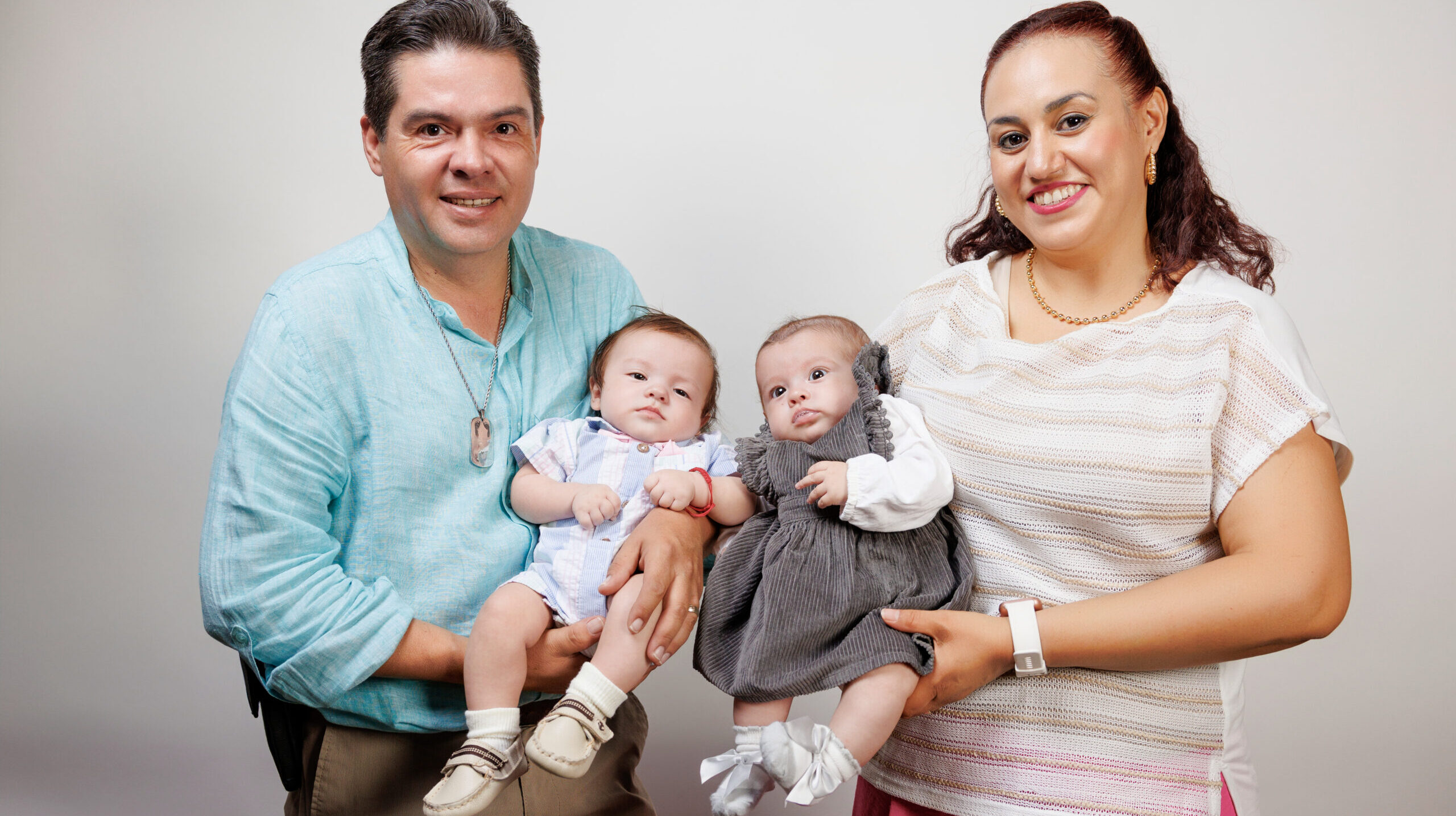
Not every fertility story begins with excitement. Some begin with exhaustion—with deep emotional wear, with the feeling of having tried everything, and with the uncertainty of whether there’s still enough strength left to begin again. Rafael and Miriam’s story is one of those.
Before arriving at Ingenes, they had gone through several unsuccessful treatments—experiences that affected not only their bodies, but also their confidence, their emotional well-being, and the way they looked toward the future. When they chose to start a new process, they did so with tired hearts, yet with a hope that refused to fade.
Today, that hope has a name: Lucas and Lucia, their babies.
This testimony is not only about a positive outcome. It is about emotional rebuilding, about learning to trust again, and about finding support that understood not just the medical side of fertility, but the human side as well.
The exhaustion no one sees
When a fertility treatment doesn’t work, the impact goes far beyond a negative result. Every failed attempt leaves a mark—on the mind, the body, and the relationship itself. Rafael and Miriam arrived at Ingenes carrying that accumulated weight.
Emotional exhaustion doesn’t always come with words. Sometimes it shows up as fear of hoping again. Other times, as constant caution—a kind of emotional shield to avoid feeling the same pain once more. For couples like them, the question is no longer just “Will it work?” but also “Do we have the emotional energy to try again?”
Acknowledging that exhaustion is the first step toward addressing it responsibly. And that’s where a specialized institute can truly make a difference.
Arriving at Ingenes: starting again, but differently
For Rafael and Miriam, coming to Ingenes didn’t mean starting from scratch—it meant continuing a journey that already had a history. And that matters. They didn’t arrive as a blank slate, but as a couple shaped by experiences, fears, lessons learned, and emotional wounds.
One of the core values of care at Ingenes is listening to the full context. Understanding what has been lived before, what worked, what didn’t, and how the couple feels in that moment. In cases involving previous failed treatments, this is especially important, because the approach cannot be automatic or generic.
It’s not about repeating a protocol—it’s about rethinking the path with clear information, empathy, and a comprehensive perspective.
The importance of feeling understood
When a couple arrives emotionally worn down, human connection becomes just as important as medical expertise. Feeling heard, validated, and supported can ease a burden that has been building for years.
In processes like Rafael and Miriam’s, support during treatment means:
- Explaining each step clearly, without creating false expectations.
- Acknowledging emotional fatigue without minimizing it.
- Making room for questions, even when they come up repeatedly.
- Moving forward with sensitivity, respecting the couple’s pace.
This kind of care doesn’t erase what has already been lived—but it does create a safer space to keep going.
During treatment: supporting, not pressuring
During their treatment at Ingenes, Rafael and Miriam went through more than a medical process—they went through an emotional one. When there is a history of failed attempts, every stage is felt more intensely.
In this context, one of the greatest contributions a specialized team can offer is support without pressure. Guidance without imposition. Information without overwhelm.
During treatment, that support can look like very concrete things:
- Understanding what is happening and why.
- Knowing what to expect at each phase.
- Having consistent follow-up and communication.
- Feeling that they are not “alone against the outcome.”
That kind of support makes the process emotionally more manageable, even during moments of uncertainty.
Rebuilding trust, one step at a time
After failed treatments, trust is often fractured—trust in the body, in medical treatments, in probabilities, even in oneself. Rafael and Miriam arrived at Ingenes with that trust wounded, like so many couples who have walked a similar path.
Rebuilding it doesn’t happen overnight. It happens through small moments:
- A clear explanation.
- A consultation where they don’t feel judged.
- Consistent follow-up.
- Professional care that doesn’t promise miracles, but does offer commitment.
Little by little, that environment allows the couple to open themselves again to possibility.
Lucas and Lucia: when hope takes shape again
Lucas and Lucia’s arrival represents far more than a positive result. In stories shaped by emotional exhaustion, a baby also symbolizes reconciliation with the path already traveled.
Lucas and Lucia are proof that even after multiple failed attempts, desire can become reality when there is proper support, persistence, and a team that understands the complexity of the process.
For Rafael and Miriam, Lucas and Lucia didn’t erase what they had been through—but he gave it new meaning. Everything that came before—the exhaustion, the doubts, the fears—takes on a different significance once the dream finally becomes real.
The value of not giving up—but not doing it alone
This family’s story carries an important message: continuing to try does not mean doing it alone or without emotional support. Finding a place that considers the couple’s full story can completely change the experience.
Ingenes supports families who arrive with very different journeys. Some begin their path there; others, like Rafael and Miriam, arrive after trying elsewhere. In these cases, previous experience is not an obstacle—it becomes a starting point for more thoughtful, personalized care.
A message for those who feel emotionally exhausted
Rafael and Miriam’s testimony may deeply resonate with couples who feel emotionally drained today—those who have tried once or many times and wonder whether it’s worth trying again.
Their story shows that:
- Exhaustion is valid.
- Fear is understandable.
- Doubt does not mean giving up.
- Asking for help is a form of self-care, not weakness.
And that with the right support, it is possible to look at the journey again with less weight and greater clarity.
Lucas and Lucia, a new beginning
Today, Rafael and Miriam are living a different stage—one not without challenges, but deeply transformative. Lucas and Lucia represent a new beginning, one that arrived after a long process of waiting and learning.
Their story doesn’t promise magical formulas, but it offers something far more real: the certainty that even when emotional exhaustion runs deep, human and professional support can truly make a difference.
Because in fertility, it’s not only the outcome that matters—it’s how the journey is lived. And for Rafael and Miriam, Ingenes was part of the path that transformed exhaustion into hope.