

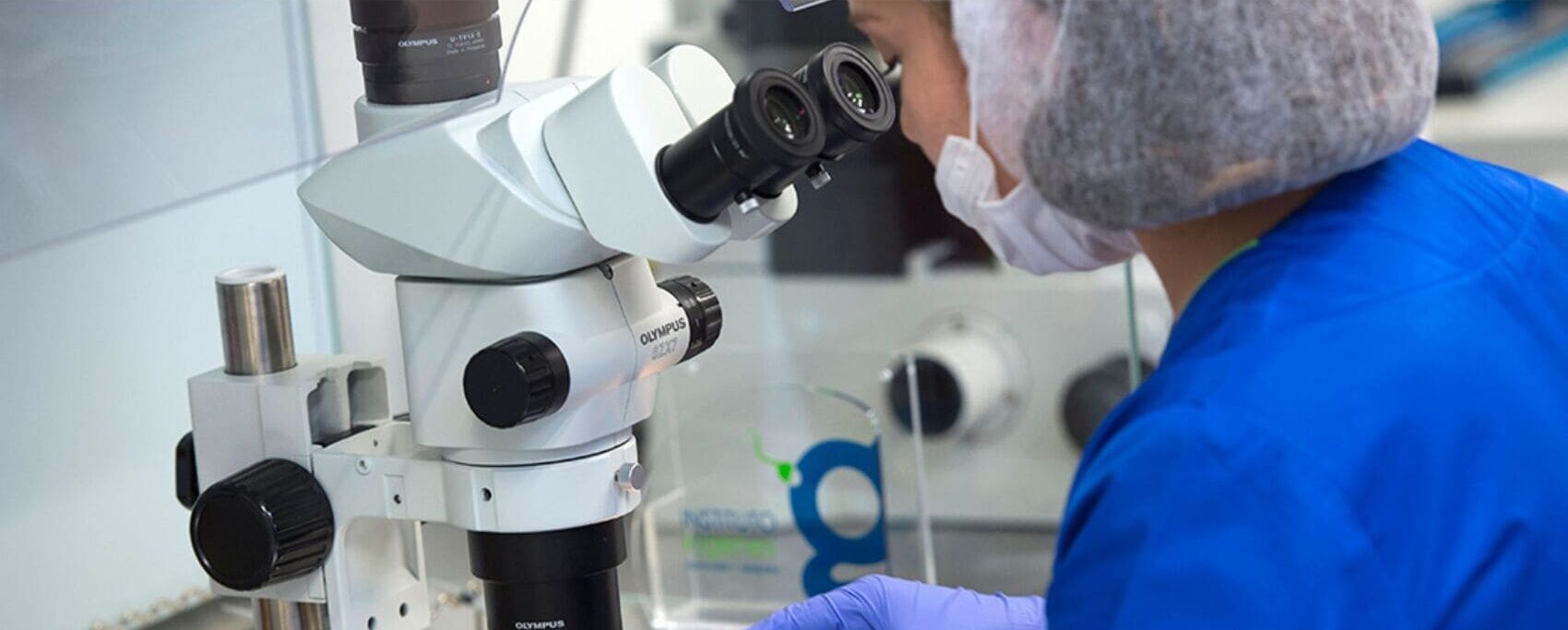
Every April 23, World Laboratory Day is observed—a date that recognizes the scientific work behind many advances in healthcare.
When we think about medical care, we usually imagine consultations, diagnoses, or treatments. However, there is a space that is rarely mentioned and that, in many cases, defines the outcome: the laboratory.
In the context of assisted reproduction, the laboratory is not a support area. It is one of the most important parts of the entire process. It is where embryos develop, where key decisions are made, and where technical precision can make the difference between trying… and actually achieving a pregnancy.
That is why talking about the laboratory is not a technical detail. It is about a fundamental part of the possibility of having a baby.
The laboratory in fertility: much more than a technical space
In treatments such as in vitro fertilization (IVF), a large part of the process does not take place inside the body, but in the laboratory.
This is where:
- eggs are evaluated,
- sperm are selected,
- fertilization occurs,
- and embryos develop during their first days of life.
This means that, during a critical stage of the process, the laboratory environment temporarily replaces the human body.
And that environment must be as precise as possible.
Factors such as temperature, gas concentration, air quality, culture stability, and how each cell is handled directly influence embryo development.
It is not just about “having a lab.”
It is about how that lab functions in every detail.
Laboratory quality does impact results
One of the least discussed aspects of fertility is that not all laboratories are the same.
Two clinics may offer the same procedure—such as IVF—but achieve different outcomes depending on how their laboratory is designed and operated.
Small variations can have a significant impact:
- temperature changes during egg handling,
- fluctuations in oxygen or CO₂ levels,
- differences in culture media,
- or even how long embryos are outside controlled conditions.
Embryo development is highly sensitive.
At this level, details are not minor.
That is why the laboratory has become one of the main differentiators in assisted reproduction.
The role of the embryologist: precision in every decision
Behind the laboratory is a key professional: the embryologist.
The embryologist does not simply perform technical tasks. They observe, evaluate, and make decisions at every stage of embryo development.
From sperm selection to embryo quality assessment, their expertise directly influences outcomes.
Some of the most important decisions happen at this level:
- which eggs are viable,
- how fertilization is performed,
- which embryos have the best potential,
- and when it is appropriate to transfer or preserve them.
This is not an automated process.
It is a process that combines science, technology, and human judgment.
Technology: when precision becomes visible
In recent years, technology has transformed the role of the laboratory in fertility.
Today, there are tools that allow for more detailed observation of embryo development and more precise decision-making.
Advanced incubation systems, continuous monitoring, genetic analysis, and improved culture methodologies have enhanced how embryos are evaluated.
This has made it possible to understand that not all embryos with good morphology have the same potential, and that some factors can only be identified through specialized technology.
Technology does not replace the specialist, but it expands their ability to analyze.
Beyond technique: the environment also matters
The laboratory is not only about equipment—it is also about the environment.
Air quality, pressure, lighting, cleanliness, and handling protocols are all essential parts of the process.
In an assisted reproduction laboratory, the goal is to recreate conditions as close as possible to the natural environment where embryo development would occur.
This involves:
- minimizing any type of contamination,
- avoiding sudden temperature changes,
- and maintaining constant stability in all parameters.
At this level, consistency is key.
It is not about doing it well once, but about doing it well every time.
When results don’t happen: what is not always evaluated
In many cases, when a treatment does not lead to the expected outcome, the focus is placed only on the patient’s diagnosis.
However, the laboratory can also be a determining factor.
A suboptimal environment, non-standardized processes, or technological limitations can affect embryo development without being obvious to the patient.
That is why it is increasingly important to understand that outcomes do not depend only on the body, but also on where a critical part of the process takes place.
Ingenes: the laboratory as a central part of the outcome
At Ingenes, the laboratory is not considered a complement to treatment—it is a central component.
Each location has its own laboratory, allowing direct control over processes and consistent standards at every stage.
This not only improves precision but also avoids transfers or variations that can affect the quality of the process.
In addition, the approach includes:
- advanced incubation technologies,
- standardized protocols,
- and a team of embryologists experienced in complex cases.
The goal is not just to perform the procedure, but to create the most favorable conditions for embryo development from the very beginning.
Because in fertility, what happens in the laboratory can define what comes next.
The true meaning of World Laboratory Day
World Laboratory Day (April 23) is not just about recognizing science.
It is an opportunity to highlight something that often goes unnoticed but has a direct impact on results.
In assisted reproduction, the laboratory is not “behind the scenes.”
It is one of the main stages.
It is where a real possibility begins to take shape.
Conclusion
When talking about fertility, the focus is often on diagnoses, treatments, or personal decisions. But there is one element that is not always given the same level of importance: the laboratory.
The quality of the lab, the experience of the team, and the precision of every process can make a significant difference in the outcome.
If you are in the process of trying to have a baby, or considering starting, knowing how and where each stage will take place is part of making an informed decision.
At Ingenes, our laboratory is a fundamental part of how fertility is approached: as a process where every detail matters.
Because when the conditions are right from the beginning, the possibilities change.And in many cases, that difference is what allows you to move forward toward what you are looking for: having a baby.