

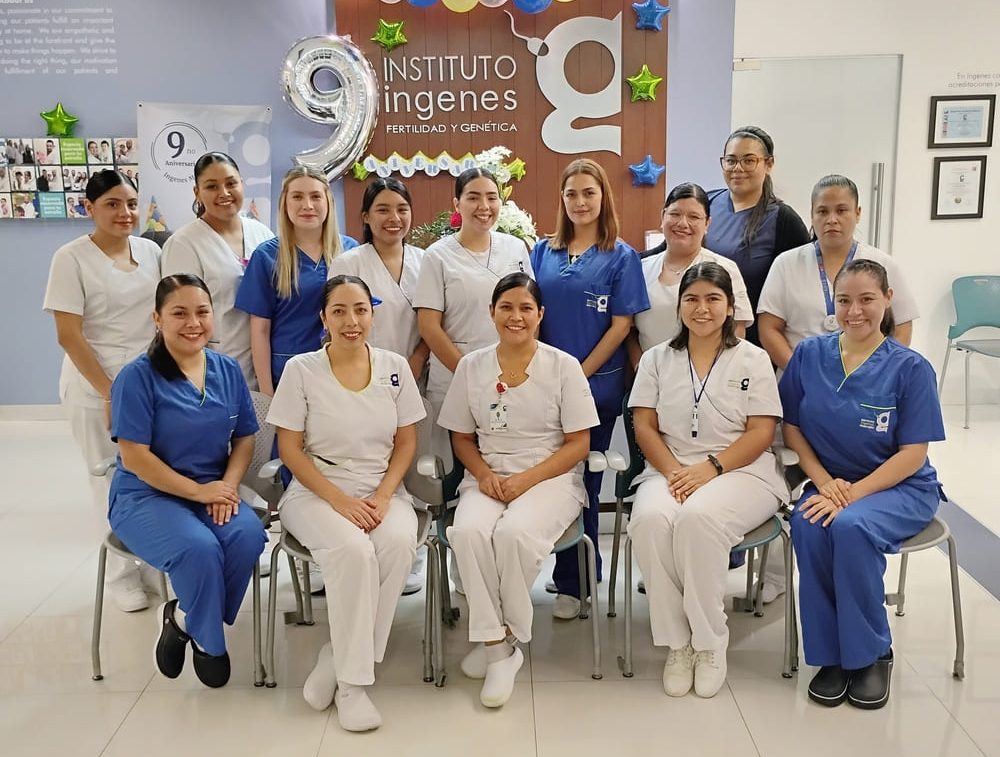
Each May 6 we celebrate International Nurses Day, a moment to thank those who, with care and professionalism, accompany so many families on their journey to motherhood or fatherhood. At Instituto Ingenes, our nurses are the close support you need at every stage.
Why do we celebrate Nurses Day?
On May 6 we recognize the millions of nurses who go beyond administering treatments: they listen to your concerns, offer you comfort, and explain each step with patience. They are the first smile when you arrive and the hug when you leave.
The role of nurses in assisted reproduction
1. Support from the First Contact
At your first consultation at Ingenes, the nurse reviews your health status, answers your questions, and gives you that comforting hug when you need it most.
2. Support in Fertility Procedures
In procedures such as in vitro fertilization (IVF), artificial insemination, or egg vitrification, they administer medications (for example, 0.25 mL of a GnRH agonist), review your hormonal tests—AMH, LH, FSH in ng/mL—and supervise each phase so you feel secure.
3. Humanizing Science
Reproductive medicine can be very technical, but with the emotional support and closeness of our nurses, each appointment becomes a space of trust and warmth.
Vocation and precision in every hormonal cycle
At Ingenes, our nurses continuously train in:
- Exact dosing of hormonal drugs (for example, 150 IU daily of FSH).
- Interpretation of AMH, LH, and FSH levels (measured in ng/mL).
- Ultrasound monitoring of your ovarian cycle.
- Emotional support during stimulation, egg retrieval, and embryo transfer.
This ensures a safe and personalized treatment.
The impact of our Nurses on your experience
“She held me up when I couldn’t go on anymore,” says one of our patients. That word of encouragement after an ultrasound or that hug after a painful injection makes all the difference in your process.
Challenges of Nursing in assisted reproduction
- Emotional burden from sharing joys and frustrations.
- Intense shifts demanding precision in every protocol.
- Continuous education to incorporate new techniques.
That’s why their dedication deserves daily recognition.
How We celebrate our Nurses
At Ingenes we organize special breakfasts, individual recognitions, and promote their professional growth. We also celebrate the role of the embryologist, that silent heartbeat in assisted reproduction.
Sources Consulted
- American Society for Reproductive Medicine. (2020). Practice Committee of the American Society for Reproductive Medicine. doi:10.1016/j.fertnstert.2020.02.019
- MedlinePlus. (2023). Ovulation induction. https://medlineplus.gov/ovulationinduction.html
- World Health Organization. (2021). WHO guidelines on research ethics in reproductive health. doi:10.1016/B978-0-12-820044-4.00008-3
- National Institute for Health and Care Excellence. (2019). Fertility problems: assessment and treatment. https://www.nice.org.uk/guidance/cg156
Frequently Asked Questions
1. What Does a Nurse Do in an In Vitro Fertilization Treatment?
They coordinate the administration of hormonal medications, schedule and perform blood tests to measure AMH, LH, and FSH (in ng/mL), and accompany you through each phase: ovarian stimulation, transvaginal ultrasounds, and embryo transfer. They adjust doses (for example, 150 IU of subcutaneous FSH) based on your response, always providing emotional support.
2. How to Prepare Emotionally for an Assisted Reproduction Cycle?
We recommend individual or couples therapy, support groups, and open communication with the team. Our nurses offer relaxation techniques, breathing exercises, and mindfulness. Maintain a balanced diet, drink 1.5 L of water a day, and do moderate exercise.
3. Why Should You Not Self-Medicate in Fertility Treatments?
Each person has a unique hormonal profile. Self-medication can unbalance your hormones and reduce your chances of success. Only a reproductive specialist, together with the nurse, can adjust doses (for example, 0.25 mg of a GnRH agonist or 150 IU of FSH) according to your response.
4. How Does Nurse Support Contribute to Mental Well-Being?
Constant accompaniment reduces anxiety and isolation. Receiving words of encouragement, clarifying doubts about symptoms or doses, and understanding lab results (for example, FSH < 10 ng/mL in the follicular phase) make your process more humane and manageable.
We know the journey can be challenging, but you are not alone. Count on the support of our nurses and always consult a specialist in assisted reproduction to receive the proper guidance.