

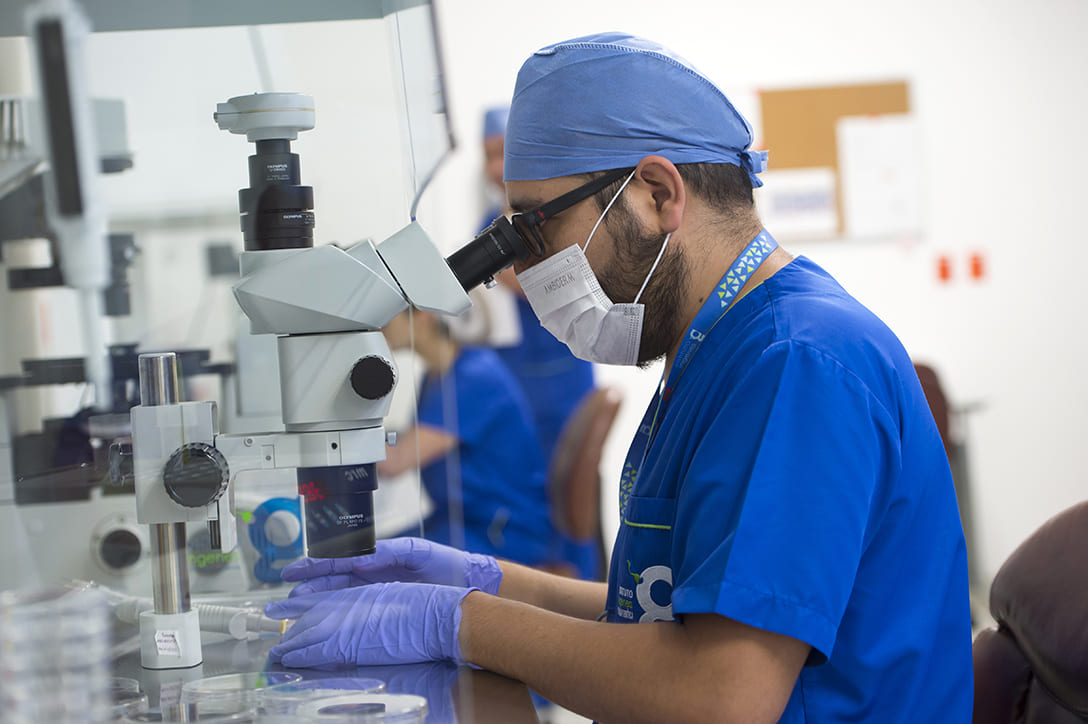
Every July 25 we celebrate Embryologist Day, a tribute to those who, from the Assisted Reproduction laboratory, work passionately so that many couples fulfill the dream of having a child. This date also marks the birth of Louise Brown in 1978, the first baby born via In Vitro Fertilization (IVF).
In this article we celebrate the fundamental role of the embryologist: their dedication, training, daily challenges, and the emotional connection they establish with each life story.
Embryologist in assisted reproduction: what do they do and why are they essential?
The embryologist is the expert in eggs, sperm and embryos in an IVF laboratory. Their tasks include:
- Performing In Vitro Fertilization (IVF)
- Intracytoplasmic Sperm Injection (ICSI)
- Culturing embryos and time-lapse monitoring
- Assessing embryo quality
- Cryopreserving gametes and embryos at –196 °C
- Applying assisted hatching
- Preimplantation Genetic Diagnosis (PGD)
More than a technician, they bring precision, clinical judgment and empathy. Every step—measuring culture medium in µL or adjusting incubators (37 °C, 6 % CO₂, 5 % O₂)—can make the difference in success rates and couples’ hopes.
How does the embryologist influence IVF success rates?
Under aseptic conditions and dim light, they control temperature, pH and humidity to mimic the uterus. They select the highest-quality blastocysts (day 5–6) and decide the optimal moment for transfer or cryopreservation. In some clinics, this has allowed them to achieve cumulative live birth rates of up to 96 % in complete programs.
At Ingenes, every embryo is treated uniquely. With state-of-the-art equipment and international protocols, our embryologists achieve concrete results and bring hope to thousands of families.
Training and skills of an embryologist
They usually study Biology, Biochemistry, Biotechnology or Medicine, specializing in Human Reproductive Biology. They master microscopy, cell culture, genetic analysis and cryotechniques. Their training never ends: conferences, certifications and research keep them up to date on culture media, microfluidics and time-lapse imaging.
They also collaborate with nursing and other embryologists worldwide, celebrating initiatives like National Nurses Day and promoting joint innovation.
The embryologist’s role in every clinical success
Although they rarely see the patient, their behind-the-scenes work is vital. From selecting the healthiest gametes to monitoring embryonic development, they guide each cycle. Relying on the latest advances in IVF, they ensure clinics apply the most innovative techniques.
At Ingenes we combine high laboratory standards with a personal approach, because we know that behind every cell beats a dream. Before self-medicating, always consult an Assisted Reproduction specialist.
Emotional challenges and rewards for embryologists
Every embryo represents hope, nerves and perseverance. Embryologists balance scientific rigor and human warmth, knowing that a precise pipetting in µL or an exact temperature control can bring joy to a family. They celebrate stories like Fernanda and Daniela’s first IUI success and the birth of babies at age 40 thanks to embryo selection.
It’s a profession that combines technical mastery and empathy to transform lives.
Thank you for creating futures
Embryologist Day honors those who, with their silent precision, change stories and build families. To you, thank you.
Frequently Asked Questions
1. What is the role of an embryologist in an IVF cycle?
They oversee the entire process: prepare culture media, select embryos and monitor incubators (37 °C, pH, CO₂, O₂). They optimize implantation and reduce risks. They perform PGD when necessary to increase the chances of a healthy pregnancy.
2. What training and certifications are required?
Bachelor’s degree in Biology, Biochemistry, Biotechnology or Medicine, followed by specialization in Human Reproductive Biology. Courses in micromanipulation, cryopreservation and reproductive genetics. Continuous training through conferences and workshops is key.
3. How does the embryologist work within the multidisciplinary team?
They collaborate with physicians, geneticists, psychologists and nurses. They share findings on embryo quality, ensure traceability and keep the patient informed, providing comprehensive support.
4. What innovations are transforming embryology?
Time-lapse to monitor development without disturbing the culture; automated ICSI systems; artificial intelligence and machine learning that predict embryo viability based on morphokinetic patterns. These technologies improve diagnosis and implantation rates.
Sources consulted
- American Society for Reproductive Medicine. (2020). “Laboratory procedures in assisted reproductive technology.” www.asrm.org
- MedlinePlus. (2023). “In Vitro Fertilization.” medlineplus.gov/ency/article/007255.htm
- De los Santos, M. et al. (2021). Advances in embryology lab techniques. Journal of Reproductive Biology, 15(4), 245–260.
- World Health Organization. (2019). “WHO laboratory manual for the examination and processing of human semen.” 6th ed.
We know this journey can be challenging. You are not alone: always consult an In Vitro Fertilization specialist to resolve your doubts and receive the support you need.