
Mexico, beyond the headlines
A different perspective on traveling to Mexico for fertility care, and a clear look at how treatment works between the United States and Mexico.
- What this guide will do
- Tell you exactly where you would be treated and who is responsible for your care, and be clear about what varies from one patient to another.
- What it won't do
- Tell you that Mexico is uniformly safe, promise a pregnancy, or suggest that every patient follows the same protocol. None of it would be true.

What's inside
Most people considering treatment in Mexico have two sets of questions: medical ones, and practical ones about the country itself. This guide takes both seriously: context first, then clinical, then logistics.
- 01 Is Mexico safe? Why the question is too broad, what headlines describe, and five things worth checking.
- 02 Why Mexico, and why Ingenes Proximity, infrastructure and a medical institute that only practices fertility medicine.
- 03 Care in the U.S., procedures in Mexico Orange County, Houston, your care team and the first consultation.
- 04 Your treatment, step by step Seven phases, two flights, and how long you actually spend in Mexico.
- 05 Where you would be treated Thirteen locations with a laboratory, three ways to choose yours, every address.
- 06 Programs and refund coverage Multicycle programs, up to 100% refund coverage, and what is included.
- 07 TripleMed™ and what makes us different Three medical areas on one case, and six structural differences.
- 08 Weighing it up What people imagine versus what the trip is, and eight questions to ask any clinic.
- 09 Travel and destinations Before you fly, getting around, and the cities where we operate.
- 10 Straight answers Eighteen questions international patients ask us most.
“Is Mexico safe?”
Why the question is too broad, what headlines describe, and five things worth checking.
It's usually the first question: sometimes asked directly, more often left unsaid until the end of a call. It is a completely fair question, and it deserves something better than reassurance.
Here is the honest answer: “Is Mexico safe?” is too broad a question to have a useful answer. Mexico is a country of nearly 130 million people spread across 32 states and almost two million square kilometers. Conditions in one state can have very little to do with conditions in another, which is exactly why the U.S. Department of State publishes its Mexico travel advisories state by state rather than as a single national verdict.
- 32states, each assessed separately
- ~130Mpeople
- 1.96Msquare kilometers
- Top 10most-visited countries worldwide
So this guide replaces one broad question with four specific ones, the questions that actually determine what your trip looks like:
01Which city will I be in, and which part of it?
You choose your clinic at the start and it does not change. Procedures happen at one of thirteen Ingenes locations with a laboratory, in established districts of major cities, and we tell you exactly which before anything is scheduled.
Answered in chapter 05: Where you would be treated02How will I move between the airport, my hotel and the clinic?
With a transfer booked before you land, a hotel in the district we recommend for patients, and a mapped route between the three. Nothing improvised on arrival.
Answered in chapter 09: Travel and destinations03Who is responsible for me while I'm there?
Your treating physician and the bilingual international team at the location where your procedures are performed, with a contact for outside office hours.
Answered in chapter 03: Care in the U.S., procedures in Mexico04How much time do I actually need to spend in Mexico?
About a week per retrieval cycle, from egg retrieval through transfer, or two shorter trips. Later transfers are shorter trips for the transfer alone.
Answered in chapter 04: Your treatment, step by stepEvery one of those has a concrete answer. The rest of this guide provides them.
“I'm not afraid of IVF. I'm afraid of the part of the trip that happens between the airport and the clinic.”
Mexico is more than the headlines
International news coverage of Mexico tends to focus on a small number of regions and a specific set of stories. Those stories are real. They are also not a description of the entire country, and they are almost never a description of the places international patients actually travel to.
- One country, many realities
- 32 states, roughly 130 million people, and an area larger than Western Europe. Colonial highland cities, Caribbean coastline, industrial metropolises and desert border towns, all inside one border.
- The world travels here
- Mexico consistently ranks among the world's ten most-visited countries, and it is the single most-visited international destination for travelers from the United States. Tens of millions of arrivals a year, most of them entirely uneventful.
- Advisories are local
- The U.S. Department of State assigns advisory levels to individual Mexican states, not to the country as a whole. Reading the advisory for your specific destination tells you far more than reading about “Mexico”.
A specific incident, in a specific municipality, often connected to organized crime and concentrated in areas that have no overlap with tourism, business travel or medical districts.
An international airport, a pre-arranged transfer, a hotel in an established district, a clinic, and the route between them, repeated over a handful of days, with a local team that does this every week.
Headlines describe one part of Mexico. Your itinerary is a much smaller, and much more specific, place.
This is not a claim that every part of Mexico is safe. Some areas genuinely warrant caution. The point is narrower and more useful: a decision about medical travel should be made about a city, a neighborhood, a route and a provider, rather than about a country of 130 million people.
Five things worth checking before any international trip
These are the same questions a careful traveler would ask about Lisbon, Bangkok or Mexico City. Applied consistently, they replace generalized anxiety with a short, answerable checklist.
Tick them off as you go
The useful question was never whether a country is safe. It's whether your trip is well planned.
Check it yourself: travel.state.gov (advisories by Mexican state)travel.gc.ca (Global Affairs Canada)wwwnc.cdc.gov/travel (CDC destination health notices)
Why patients travel here for fertility care
Proximity, infrastructure and a medical institute that only practices fertility medicine.
Mexico has become a significant destination for medical travel for reasons that are mostly unglamorous: it is close, it is well connected, and its major cities have private medical infrastructure built to international standards.
Close enough to be practical
Most major U.S. hubs have nonstop service to at least one Mexican city where we operate: a few hours in the air rather than a day of travel.
Shared time zones
Mexico's time zones overlap with the continental United States. Calls happen during business hours, and there is no jet lag to recover from before a procedure.
Specialized fertility centers
Assisted reproduction depends less on hospital size than on the embryology laboratory and the team running it. Our centers are built around exactly that.
Private medical infrastructure
Mexico's major cities have well-developed private healthcare sectors and clinicians who routinely treat international patients.
Room to recover comfortably
A treatment trip does not have to feel like a hospital stay from beginning to end. Patients can plan quiet time around their appointments.
Continuity after the trip
The concern with treatment abroad is usually follow-up. Our model is built to address it directly; that is the subject of the next section.
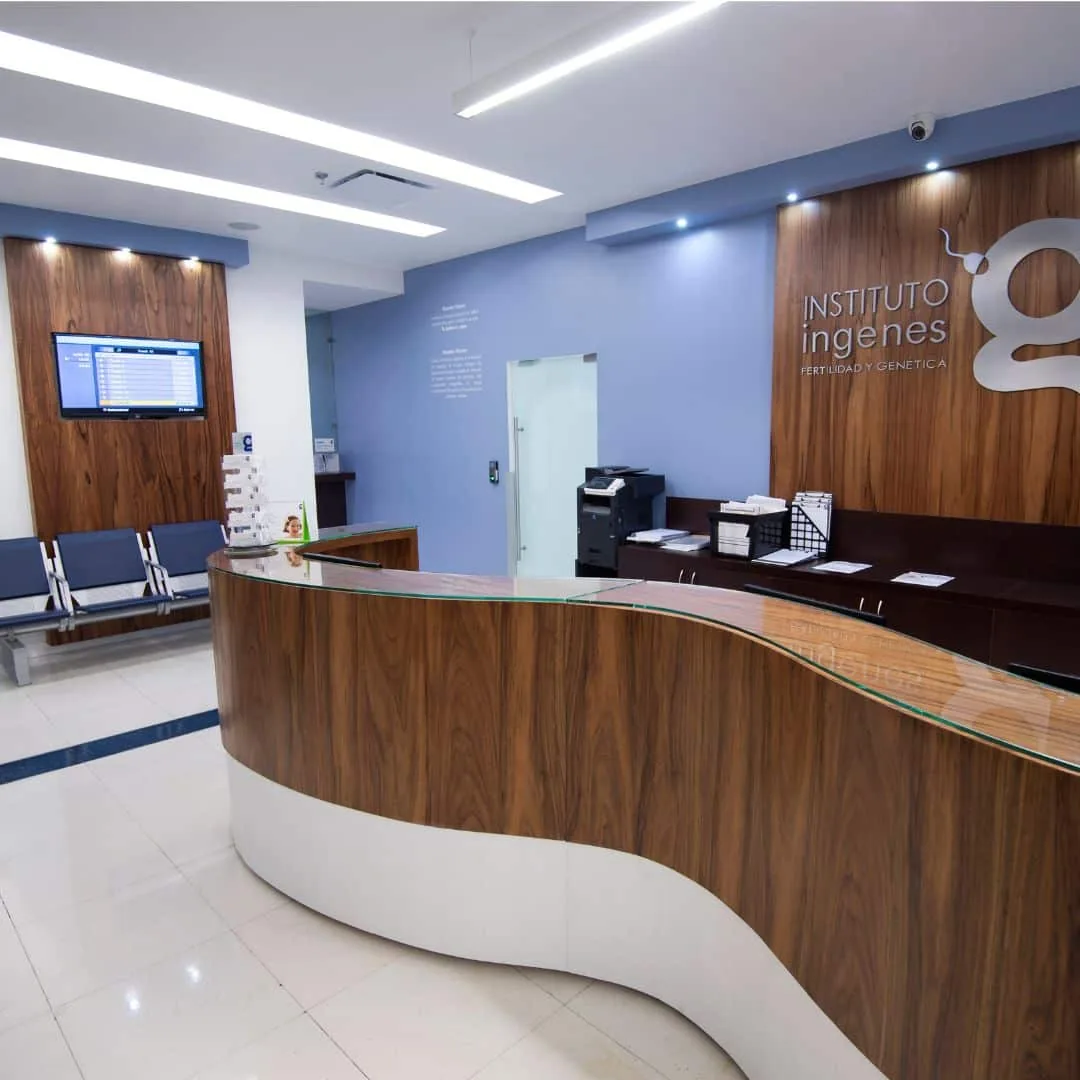
Why thousands of families choose Ingenes
Instituto Ingenes was founded in 2005 as a medical institute dedicated to one thing: helping people who want a baby take one home. More than 75,000 Ingenes babies later, we are a network of 19 locations across Mexico and two in the United States, and fertility medicine is still the only medicine we practice.
That focus shapes everything a patient experiences here: physicians who treat infertility exclusively, embryology laboratories and operating rooms that belong to Ingenes, programs designed around the reality that treatment often takes more than one attempt, and financial terms tied to the outcome.
It also shapes how we define success. The measure that matters to us is a baby at home, beyond a positive test or a single good cycle. That definition is written into the structure of our Multicycle Programs and their refund terms.
- 2005year founded
- +75,000Ingenes babies born
- 19locations across Mexico
- 13with laboratory and operating room
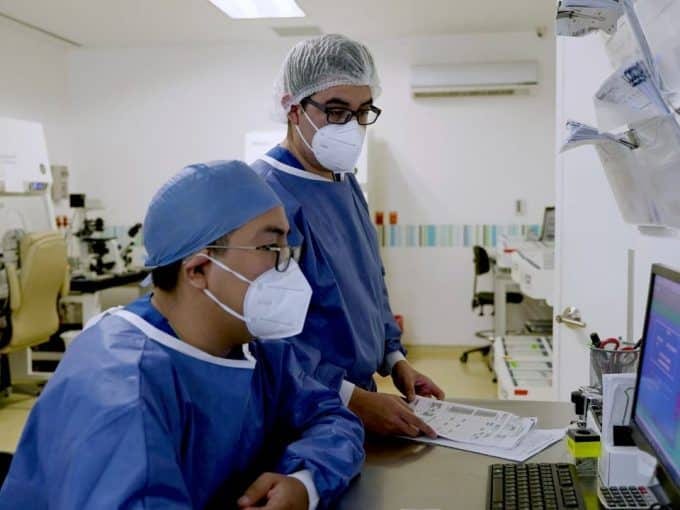
- Certified by RedLara
- RedLara, the Latin American Network of Assisted Reproduction, has certified Ingenes' medical practices and laboratory. Certification by a regional scientific body is an external check on how a center works: its protocols, its laboratory conditions and the way it reports what it does.
- One specialty, one standard
- Every laboratory and every operating room used for an Ingenes treatment is our own. Your eggs, your sperm sample and your embryos stay inside Ingenes infrastructure, handled by Ingenes embryologists, from retrieval through transfer. They are never sent to an outside facility.
Care in the United States. Procedures in Mexico.
Orange County, Houston, your care team and the first consultation.
You don't have to choose between U.S.-based support and treatment in Mexico. The Ingenes model connects the two: consultations and follow-up close to home, and the procedures that require an operating room and an embryology laboratory performed at an Ingenes facility in Mexico.
- United States Start
Consultations, testing and clinical follow-up through Ingenes' U.S. locations.
- Mexico Procedures
Egg retrieval, laboratory fertilization, embryo culture and embryo transfer.
- United States Continue
Pregnancy testing, ultrasound and continued support after you return home.
Begin in the United States
Ingenes has patient locations in Orange County, California and Houston, Texas. Initial consultations, diagnostic workup and clinical follow-up can take place there, with the medical team following your case as your treatment plan develops.
Prepare with your Ingenes team
The preparation phase (ovarian stimulation, endometrial preparation, blood work and monitoring ultrasounds) is managed with medical guidance close to home before you travel. Your team plans your trip around the phase of your cycle.
Travel to Mexico for the procedures
Depending on your treatment plan, this is where egg retrieval takes place, where a sperm sample is provided and prepared when applicable, and where fertilization, embryo culture, embryology and embryo transfer are performed, at an Ingenes location with the required operating room and laboratory.
Return home with continued support
After the transfer you return home, with pregnancy testing, ultrasound confirmation and follow-up consultations supported through the U.S. locations. Specific arrangements depend on your plan and should be confirmed with your care team.
Treatment plans are individual. This sequence describes the general structure of the model; each patient's protocol and schedule are set by their medical team.
Orange County and Houston
Two U.S. locations where your journey can begin, and where support continues once you're back.

Serving patients across Southern California and the Southwest, with straightforward connections to our locations in northern and central Mexico.
View location
Serving patients across Texas and the Gulf region, with direct air connections to several of the Mexican cities where procedures are performed.
View location- Consultation
- Meet your care team and review your history, diagnosis and options.
- Workup & monitoring
- Testing, ultrasounds and stimulation monitoring before any travel.
- Follow-up
- Pregnancy testing and continued support after you return home.
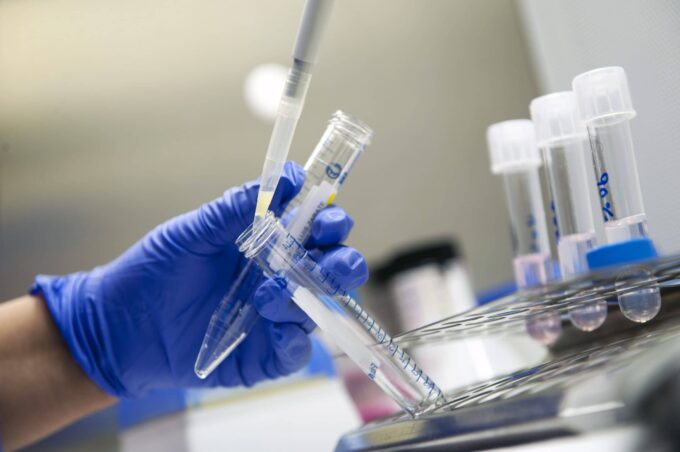
Who you'll meet, and what we do on site
A U.S. Ingenes location is a working clinic with its own medical team. Most of what happens before you travel, and everything that happens after you come back, happens here.
The team
Medical Director
Responsible for your medical assessment, diagnosis, indications and clinical follow-up.
Nurse Practitioners
Medical support and follow-up throughout the process.
Phlebotomist
Blood draws and support for laboratory studies.
Medical Assistants & MA Coordinator
Constant accompaniment through every stage, coordinated so nothing is lost between appointments.
Patient experience team
Orientation, communication and support from your first contact to your last.
Manager and reception
Team management, service and, often your very first contact with the clinic, a front desk whose job is to make the place feel like somewhere you can ask anything.
Studies and services on site
- Laboratory studies for your follow-up, processed with Labcorp.
- Semen analysis, performed at the clinic.
- Genetic studies through Natera, when medically indicated.
- Ultrasounds and medical consultations, including monitoring during stimulation according to your program.
- Estradiol testing during stimulation as part of clinical monitoring.
We follow strict rules on privacy and the handling of patient information, in accordance with HIPAA.
What our patients tell us they notice
Care that is practically hand in hand. Personalized follow-up from day one, with appointments scheduled almost immediately according to your needs and our availability.
Direct communication. You have our team's phone numbers. Questions get answered when you have them, and the medical, patient-experience and administrative teams stay in constant contact so your information doesn't get lost between them.
The moments in between. We mark a graduation with a gift between weeks 8 and 10. In Houston, every positive beta is planted as a new plant in our Happy Positive Garden.
It begins with one consultation
Before any plan, price or travel, we need a precise picture of what is affecting your fertility. That is the Initial Program: an evaluation by a reproductive specialist and a financial advisor, so you leave with a treatment plan and a payment plan built around your case.
- Specialist and financial advisor
- Your physician evaluates and recommends a treatment; your financial advisor then builds personalized payment plans and explains financing and loan options.
- Transvaginal ultrasound
- Assesses the uterus and ovaries and measures your ovarian reserve. It is a painless test.
- Semen analysis
- Evaluates sperm across three measures: morphology (shape), motility (the ability to move and fertilize) and concentration.
Two ways to have your first appointment
Consultation
2 h 30 min to 3 hours. Arrive 15 to 30 minutes early to complete your forms. The ultrasound and semen analysis are performed during the same visit.
USD $50Medical assessment
60 to 90 minutes by video call. At the end you schedule your second appointment directly with your specialist for the ultrasound and semen analysis.
USD $75, covering the call, the second appointment and both studiesWhat happens during the visit
- Your medical assistant receives you and takes your initial information.
- Your specialist reviews your medical history and recommends the treatment to follow.
- Your financial advisor presents the price and explains our fertility programs.
- You schedule your second appointment.
No passport or visa needed for this. A first consultation only requires you; documents matter later, once you decide to begin treatment.
What to expect, step by step
Seven phases, two flights, and how long you actually spend in Mexico.
This is our timeline for international patients who choose an Ingenes U.S. location. It shows which phases happen in the United States, which happen in Mexico, and approximately how long each one takes.
- United States
- Mexico
- Mexico · IVF laboratory
- Flight
Initial Program
- First and second consultations
- Medical analysis and exams, including ultrasound and a transfer test
- A mindfulness session
Ovarian stimulation & endometrial preparation
- With your own eggs, or donor eggs when required
- 3-4 consultations
- 3-4 blood tests, including estradiol measurements
- 3-4 ultrasounds
- Egg donation program: donor selection, donor medications, ultrasounds, blood tests and donor healthcare
Egg retrieval & sperm capacitation
- Retrieval performed in a procedure room under anesthesia, with andrology laboratory work
- With donor gametes: our Mexican egg and sperm banks, donor selection, and thawing and capacitation of a bank sample
- You can choose whether to use your own or donor eggs or sperm with each cycle
In vitro fertilization
- Whichever technique your plan requires: conventional IVF, ICSI or PICSI, performed in the IVF laboratory
Extended embryo culture
- Monitoring by embryology specialists
- Extended culture for 3 to 5 days
- Embryo preparation for transfer, and assisted hatching when required
Embryo transfer
- Fresh embryo transfer carried out in the procedure room
- Remaining embryos can be vitrified for up to a year; freezing does not apply where eggs or sperm were provided by a donor
Pregnancy test
- Blood pregnancy test
- Ultrasound to check the gestational sac
- 1-2 medical consultations
- Two ways to travel
- You can extend your stay in Mexico between egg retrieval and embryo transfer, or return home and travel back for the transfer. If you fly home in between, you need to be back in Mexico for the transfer.
- How long am I in Mexico?
- From retrieval through transfer, with 3-5 days of culture in between: about a week, or two shorter trips if you fly home after retrieval. If that cycle produces more than one healthy embryo, the rest are vitrified, and each later transfer is a shorter trip for the transfer alone.
- Travel documents
- U.S. and Canadian citizens travel to Mexico with a valid passport. Other nationalities should check whether a visa is required, using the official list published by the Mexican government at gob.mx. Bring photo identification to each clinic visit. Not yet, though. None of this applies to your first consultation. Documents matter only once you decide to begin treatment and we start scheduling your cycle around real dates.
Durations shown are typical ranges for the phases described and may vary for each patient. Your plan may include additional steps, different techniques or a different sequence.
Thirteen locations with a laboratory and operating room
Thirteen locations with a laboratory, three ways to choose yours, every address.
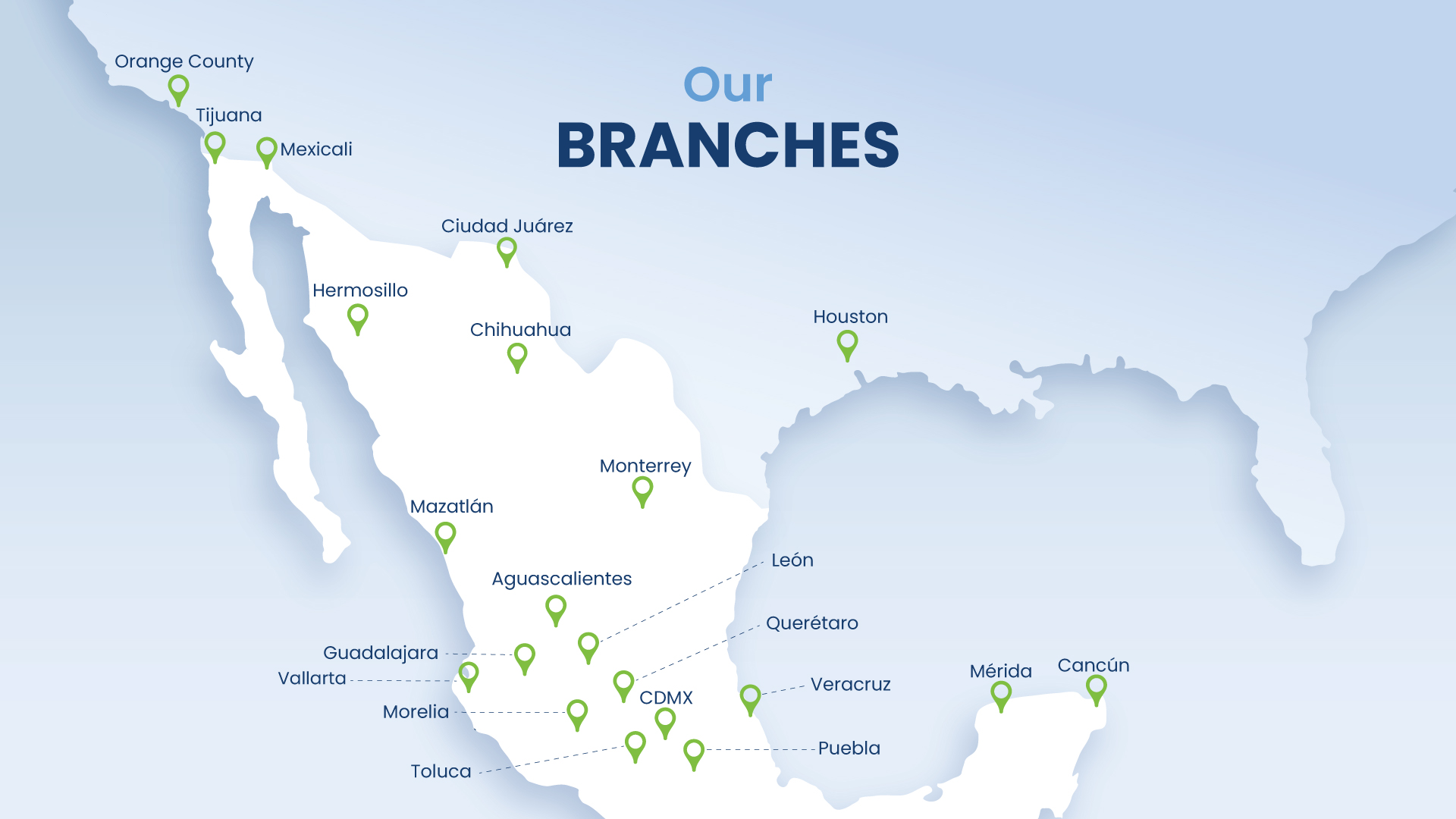
Every procedure that requires an operating room and an embryology laboratory is performed at one of these Ingenes locations.
- Ciudad de México
- Guadalajara
- Monterrey
- Puebla
- Querétaro
- Mérida
- Cancún
- Puerto Vallarta
- Tijuana
- Ciudad Juárez
- Chihuahua
- Hermosillo
- Mazatlán
Every laboratory and operating room used for an Ingenes treatment belongs to Ingenes. Owning our own laboratories is also what makes the TripleMed™ model possible.
You choose your clinic at the beginning
You are not moved between locations along the way. At the start you choose one Ingenes clinic, and that clinic follows your treatment from the first consultation onward. The three options below differ only in whether the procedures happen in the same building or require travel.
Where would you like to start?
Orange County or Houston. Consultations, stimulation monitoring and follow-up happen there, and your procedures take place at one of our thirteen Mexican locations with a laboratory, agreed with your team.
Orange County or Houston → one of the 13Consultations, monitoring, retrieval, laboratory work and transfer all take place at the same clinic. There is no second location and no transfer of your case.
Everything in one placeWhere to find us
- Ciudad de México Laboratory + OR Carretera México-Toluca 5420, Piso 5, El Yaqui, C.P. 05320, Cuajimalpa, CDMX
- Guadalajara Laboratory + OR Av. Mar del Sur 2014, Local 102, Country Club Plaza, Col. Country Club, C.P. 44610, Guadalajara, Jal.
- Monterrey Laboratory + OR Av. Revolución 2703, Centro Empresarial Nuevo Sur, Torre 1, Piso 8, Col. Ladrillera, C.P. 64830, Monterrey, N.L.
- Puebla Laboratory + OR Lateral Sur de la Vía Atlixcáyotl 6514, Oficina 300, Piso 3, San Bernardino Tlaxcalancingo, C.P. 72820, San Andrés Cholula, Pue.
- Querétaro Laboratory + OR Av. Paseo Monte Miranda 5, Piso 9, Col. Distrito Piamonte, C.P. 76240, El Marqués, Qro.
- Mérida Laboratory + OR Calle 20 No. 235, Piso 8, Col. Altabrisa, C.P. 97130, Mérida, Yuc.
- Cancún Laboratory + OR Av. Bonampak, Mz. 1, Lote 4C, Locales 306 y 307, Súper Manzana 4A, C.P. 77500, Cancún, Q. Roo
- Puerto Vallarta Laboratory + OR Av. Las Palmas 818, Plaza Rivera Ameca, Local 15, C.P. 48291, Puerto Vallarta, Jal.
- Tijuana Laboratory + OR Diego Rivera 2311, Piso 10, Zona Urbana Río Tijuana, C.P. 22010, Tijuana, B.C.
- Ciudad Juárez Laboratory + OR Calle México 9031, Edificio Santa Fe, Fracc. Misión de Los Lagos, C.P. 32668, Ciudad Juárez, Chih.
- Chihuahua Laboratory + OR Paseo Vistas del Sol 6801, Azenzo Torre Corporativa, Piso 9, Col. Villas del Sol, C.P. 31124, Chihuahua, Chih.
- Hermosillo Laboratory + OR Blvd. Paseo Río Sonora Nte. 70, Vado Prime Center, Locales L21-L23, Col. Río Sonora Hermosillo XXI, C.P. 83270, Hermosillo, Son.
- Mazatlán Laboratory + OR Av. Reforma 2007-B, Piso 10, Local 10-A, Col. Flamingos, C.P. 82149, Mazatlán, Sin.
- Aguascalientes Consultations Prolongación Gral. Ignacio Zaragoza 4200, Int. I-3201, Col. Trojes de Alonso, C.P. 20116, Aguascalientes, Ags.
- León Consultations Blvd. Juan Alonso de Torres Pte. 1445, Valle del Campestre, C.P. 37295, León, Gto.
- Mexicali Consultations Calle Álvaro Obregón 1257, Piso 1, Col. Segunda Sección, C.P. 21100, Mexicali, B.C.
- Morelia Consultations Av. Acueducto 1178, Piso 2, Col. Chapultepec Norte, C.P. 58260, Morelia, Mich.
- Toluca Consultations Av. Ignacio Comonfort 1300, Torre Zero Providencia, 4.º piso, Local 401, Col. La Providencia, C.P. 52177, Metepec, Edo. de México
- Veracruz Consultations Blvd. Adolfo Ruiz Cortines, Lotes 7 y 8, No. 2202, Local A, Fracc. Costa de Oro, C.P. 94299, Boca del Río, Ver.
- Orange County, CA U.S. 100 Pacifica, Suite 100, Irvine, CA 92618
- Houston, TX U.S. 16000 Stuebner Airline Rd, Suite 150, Spring, TX 77379
Addresses are listed for reference. Confirm your appointment location with your coordinator before traveling.
More than a single chance
Multicycle programs, up to 100% refund coverage, and what is included.

For many patients the realistic path to a baby involves more than one cycle, and a program built around that reality works very differently from paying cycle by cycle.
Why more than one cycle matters
In assisted reproduction the chance of a live birth accumulates across cycles, and what one cycle teaches us about your response informs the next. A cycle that doesn't result in a pregnancy is frequently part of the process, and does not on its own mean treatment won't work.
What a Multicycle program is
Instead of buying one cycle at a time, a Multicycle program covers up to four In Vitro Fertilization cycles under one agreement, with defined inclusions and refund coverage attached. The point is to remove the pressure of deciding whether you can afford to continue after every attempt.
A cycle is not the same as an attempt
If a cycle produces several healthy embryos, we vitrify them and use them in later transfers. A new cycle (new stimulation, new retrieval) begins only once those embryos have been used. So a two- to four-cycle program can give you more chances at pregnancy than its number of cycles suggests.
Two different things, often confused
Our BEC 4 Plus Multicycle Program reaches a cumulative success rate of up to 96%, based on more than 20 years of documented clinical experience and over 75,000 Ingenes babies. “Cumulative” means across the cycles of the program; “up to” means it is a program-level figure, rather than a prediction for an individual. Your own likelihood depends on your diagnosis, age, ovarian reserve and how you respond.
Separately from any clinical figure, our Plus Multicycle Programs include refund coverage of up to 100% of your investment if you do not achieve an ongoing pregnancy after completing the program. It is a financial commitment we put in writing and back legally.
A success rate and refund coverage are different things, and neither is a guarantee of a baby. No clinic can promise a pregnancy or a live birth. What refund coverage does is define what happens financially if treatment does not succeed.
We don't promise certainties. We do make a real commitment.
If you do not achieve an ongoing pregnancy, you recover up to 100% of your investment. We don't think a family should start from scratch and pay for everything again because the result didn't come. Refund coverage is our way of putting that in writing, and the policy is backed by a Notary Public.
BEC 3 Protección 50
A Multicycle program with three cycles and partial refund coverage, for patients who want access to several attempts with moderate financial backing.
BEC 3 Plus
The expanded version of BEC 3, with extended refund coverage. More backing if the three cycles do not lead to an ongoing pregnancy.
BEC 4 Plus
Four cycles with maximum refund coverage. Reaches up to a 96% cumulative success rate based on our documented clinical experience.
- 1 Your plan is designed first
- After your First Consultation we design a personalized plan that can include up to four In Vitro Fertilization cycles. If you choose a Plus Multicycle Program, refund coverage comes with it as additional backing.
- 2 Coverage activates when the program is complete
- The refund activates on completing all the cycles included in your program without achieving an ongoing pregnancy. The percentage you recover (up to 50%, 75% or 100%) depends on the program you chose.
Things other clinics often bill separately
Comparing IVF quotes is difficult because two programs with similar headline prices can cover very different things. Our IVF Multicycle Programs include the following.
- One year of embryo vitrification. Embryos not transferred in your fresh cycle are frozen and stored for a year.
- National egg and sperm bank, optional, when donor gametes are part of your plan.
- Fresh egg donors, where your treatment plan calls for them.
- Assisted hatching, when medically indicated.
- ICSI and PICSI, the fertilization techniques used to improve the chance of success, included rather than charged as add-ons.
- Refund coverage of up to 50%, 75% or 100%, according to the program you choose.
- Written before you commit
- Inclusions, exclusions, cycle count and refund conditions are set out in your program agreement.
- Designed for continuity
- The program covers more than one attempt so a single result does not force a financial decision.
- Measured by a baby at home
- The commitment is written around an ongoing pregnancy and a baby, beyond a positive test.

Three medical areas, working on the same case
Three medical areas on one case, and six structural differences.
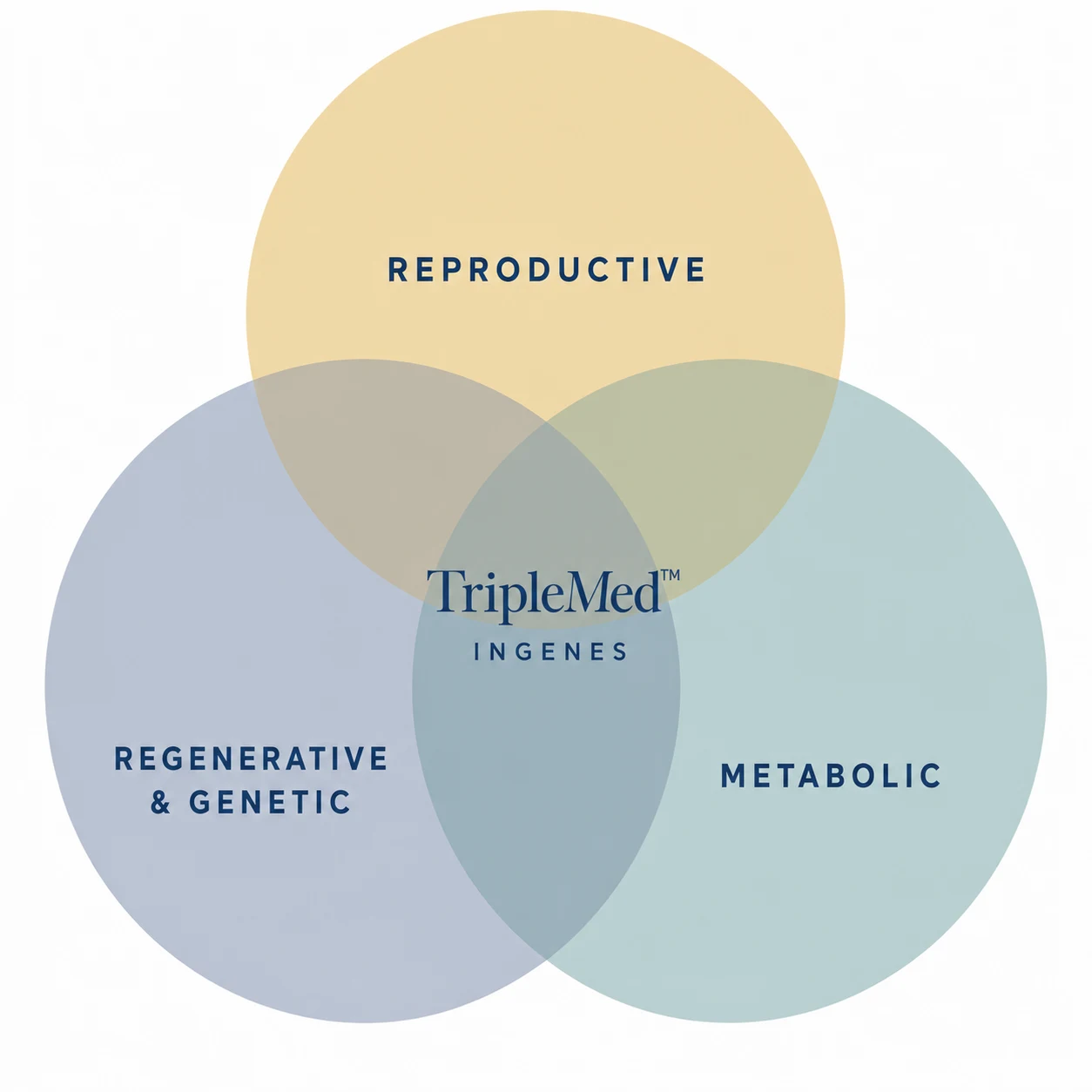
TripleMed™ is a care model that brings three areas of medicine together in one plan. Each pillar has a clear purpose; the powerful part is applying them in a coordinated way, adjusted to your specific diagnosis. Because our laboratories in Mexico are our own, all three can operate under one roof on the same patient.
The full spectrum of low and high complexity: this is where conception happens.
- IVF: conventional, ICSI and PICSI
- Artificial insemination and timed intercourse
- ROPA method for female couples
- Multicycle Programs reaching up to 96% cumulative success
- Egg freezing and sperm preservation
- Egg and sperm donation through DonaVida
- Surrogacy when carrying a pregnancy is not possible
For when repeating a protocol isn't enough: technologies in which we are worldwide pioneers.
- Ovagen™: ovarian tissue regeneration with stem cells, for low ovarian reserve or premature ovarian failure
- Endogen™: restoration of damaged endometrium with stem cells
- IVF MORE™: egg restoration at the mitochondrial level
- Procelk™: exosomes to enhance gamete and embryo quality
- PGT-A and PGT-M embryo genetic studies
- Eligender™, Implantation Score and non-invasive prenatal testing
A metabolically prepared body responds better to fertility treatment. Egg quality, endometrial receptivity and implantation depend on more than the reproductive system.
- Longevity Test, a precision diagnostic of your biological environment
- Insulin resistance and hormonal balance
- Nutritional status and personalized nutritional intervention
- Systemic inflammation and oxidative stress
- Gut microbiome
“Why doesn't it work for me?”
All the tools on the table
Many plans use one or two pillars. What matters is that the decision is made with every available option in view, by people who work with all of them.
- Step oneFirst Consultation
A comprehensive evaluation: history, previous attempts, current studies and the analyses needed for a complete picture.
- Step twoMultidisciplinary review
A reproduction physician, embryologist, geneticist, regenerative specialist and metabolic specialist review your case together.
- Step threeYour personalized plan
One, two or three pillars, combined according to your specific diagnosis.
What that looks like for different patients
- A young, healthy woman preserving her fertility uses Reproductive Medicine, backed by a team that knows every option she may need later.
- A woman with low ovarian reserve can combine IVF with IVF MORE™ or Ovagen™ where medically indicated.
- A woman with a refractory endometrium benefits from Endogen™ integrated into her IVF cycle.
- A patient with Polyendocrine Metabolic Ovarian Syndrome (PMOS, formerly PCOS) or insulin resistance benefits from the metabolic pillar before and during reproductive treatment.
- A couple with male factor accesses IVF with ICSI or PICSI plus genetic diagnosis.
- A male couple or a single mother by choice accesses the full model, adapted to their needs.
What for many institutions is “the next step if IVF fails” is, at Ingenes, integrated from the beginning whenever the case calls for it. That is what allows us to keep working on cases other institutions consider closed. Every case is different. The model is the same.
Discover TripleMed™What makes us different?
Six things that are structural: differences in how we are built, rather than adjectives about how good we are.
- 01A cross-border model
Most medical-travel decisions mean leaving your care behind. Here, consultations and follow-up happen at the clinic you chose, including Orange County and Houston, while procedures are performed where the laboratory is.
- 02TripleMed™: three medical areas, one plan
Reproductive, regenerative and genetic, and metabolic medicine applied in a coordinated way to the same case, by specialized teams working as one.
- 03Our own laboratories and operating rooms
Every laboratory and operating room used for an Ingenes treatment is ours. Your eggs, sperm sample and embryos stay inside Ingenes infrastructure, handled by Ingenes embryologists.
- 04A network you choose from, once
Nineteen locations in Mexico and two in the United States. You pick your clinic at the start and stay with it; the only travel is to the location that holds the laboratory, and only for the procedures themselves.
- 05Programs built for more than one attempt
Multicycle Programs treat IVF the way the medicine actually works, as a process that may take up to four cycles, instead of pricing each attempt in isolation.
- 06Certified, and accountable for the outcome
Our medical practices and laboratory are certified by RedLara, and our Plus Multicycle Programs carry refund coverage of up to 100%, backed by a Notary Public.
“Wouldn't it be easier to just stay home?”
What people imagine versus what the trip is, and eight questions to ask any clinic.

Often, yes, and if a clinic near you offers what you need, that is a perfectly good answer. But most people assume the trip is bigger than it is. Here is what traveling really involves, and what it gives you in return.
What the trip buys you
Up to four cycles, decided once
More chances than four, in fact: a cycle with several healthy embryos gives more than one transfer. Affording the next try is settled at the start.
Refund coverage of up to 100%
Backed by a Notary Public. Part of the financial risk sits with us, something few clinics will put in writing.
Options that aren't on every menu
Ovagen™, Endogen™, IVF MORE™, Procelk™ and the metabolic pillar, available from the start rather than as “the next step if IVF fails”.
Included, not added on
ICSI and PICSI, assisted hatching, a year of vitrification and donor bank access are included in the program.
Time, which matters medically
Appointments almost immediately, subject to availability. In fertility treatment, months on a waiting list are not neutral.
You keep your care
The clinic you chose stays yours from first consultation to pregnancy test. Only the procedures happen elsewhere.
Eight questions to ask any clinic, including us
The honest way to decide is to ask the clinic near you and ask us the same eight questions, in writing, and put the two answers side by side.
01What is included in the price?
Specifically: ICSI or PICSI, assisted hatching, embryo freezing and how long, donor gametes, genetic testing.
02How many cycles does this cover?
And what does a second or third cycle cost if the first doesn't work?
03What happens financially if treatment fails?
Is there any refund, and is it a written, legally backed commitment?
04Who runs the laboratory?
Is the embryology lab the clinic's own, or is the work sent out?
05What happens if a cycle fails?
Is the approach reviewed by more than one specialty, or is the same protocol repeated?
06How soon can I start?
First consultation, and then the first cycle.
07Who follows me day to day?
Names and roles, and how I reach them outside appointments.
08What does travel actually add?
Number of trips, days away, and which phases happen where.
- Ask for it in writing
- An itemized quote, rather than a verbal estimate. We'll give you ours.
- Bring someone with you
- Two people hear a consultation better than one, in either country.
- Ask us the hard ones
- Including the ones in this guide. If an answer isn't clear, say so.
If staying home is the right answer for you, that's a good outcome too.
We would rather you decide with the full picture than enroll with half of it. What we ask is only that the comparison be a real one: the same questions, the same written answers, and a clear view of what each option includes, what it costs if it doesn't work the first time, and what happens next if it doesn't work at all. And if you have had treatment before, the comparison that matters is between what was tried and what hasn't been tried yet.
Travel with clarity
Before you fly, getting around, and the cities where we operate.
As with any international trip, your experience depends on the city, the neighborhood, the transportation and the travel habits you choose. These are the practical steps that make the difference.
Before you fly
Tick them off as you go
Getting around
You have several options, and we are happy to talk you through which ones patients use in your destination city:
- Hotel transfer services, booked through your hotel in advance.
- Private transfer companies, reserved online before you travel.
- App-based rides, widely available in the cities where we operate.
- Authorized airport taxis, purchased at the official counter inside the terminal rather than from the arrivals hall.
Avoid unfamiliar areas late at night as you would in any large city, keep the clinic's address and phone number on your phone and on paper, and tell someone at home your itinerary.
This guide does not claim that any city is completely safe. It claims something more useful: the decisions above (where you stay, how you move and who you can call) are the ones that shape your experience, and all of them are within your control.

Your treatment journey can also be a travel experience
Fertility treatment is serious, and this is not an invitation to treat it as a vacation. But the days around your appointments are still your days, and the cities where we operate are some of the most rewarding places in the Americas to spend them.
 Mexico City
One of the great capitals: world-class museums, Chapultepec's parkland, and a dining scene that draws people across oceans.
 Cancún
Caribbean coastline and one of Latin America's best-connected international airports, with the Riviera Maya alongside.
 Guadalajara
A historic center, a serious design and food culture, and the highlands where tequila and mariachi actually come from.
 Monterrey
Mountains on every horizon, contemporary architecture, and Mexico's most business-oriented city.
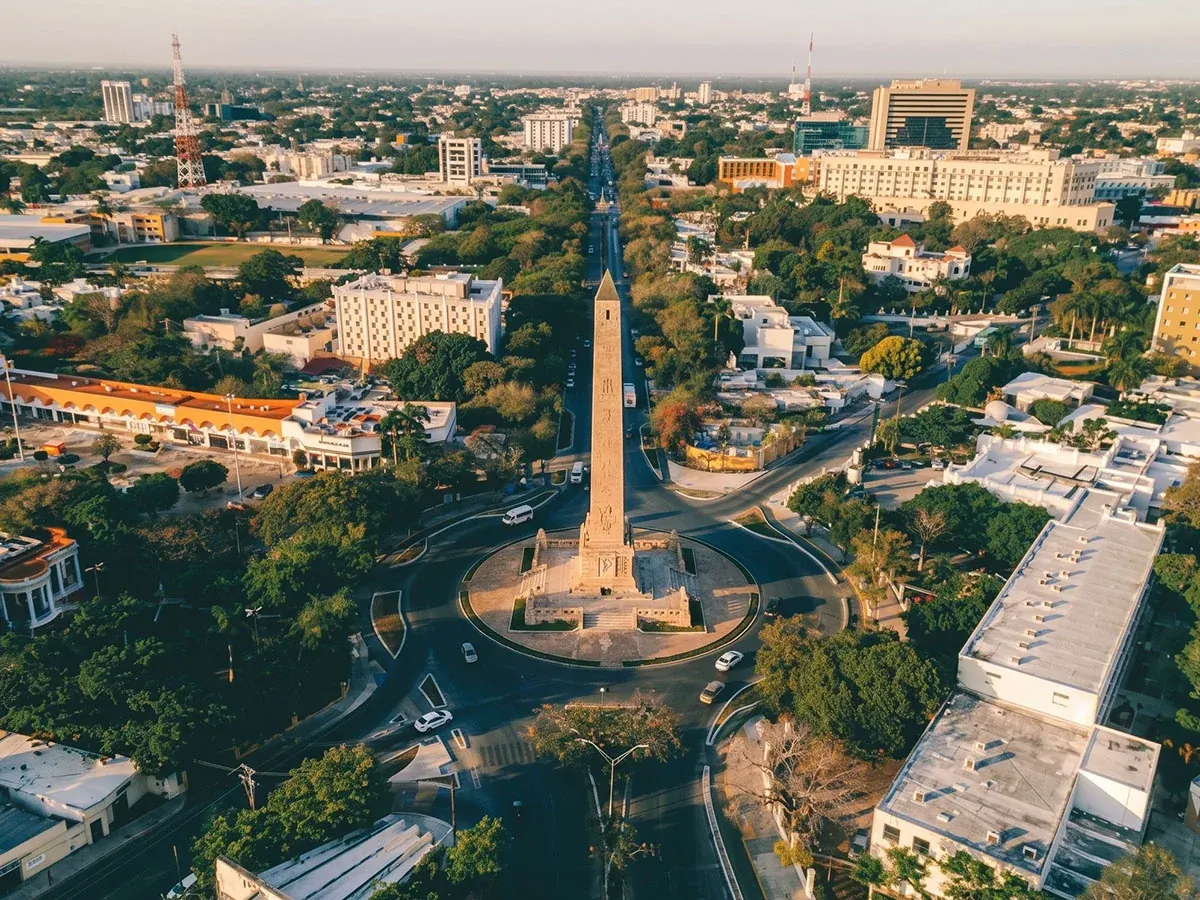 Mérida
Colonial Yucatán: walkable, low-rise and unhurried, with cenotes and Maya sites within a short drive.
 Puerto Vallarta
A Pacific bay backed by the Sierra Madre, a long malecón, and a town built for slow days.
 Tijuana
A border city with an outsized culinary reputation, and the gateway to the Valle de Guadalupe wine country.
None of this is required. Plenty of patients fly in, complete their treatment and fly home, and that is a perfectly good way to do it.
Straight answers
Eighteen questions international patients ask us most.
Is Mexico safe for fertility treatment?
Mexico is a large, diverse country, and conditions vary significantly by state and by city, which is why U.S. travel advisories are issued state by state. The question worth asking is narrower: which city, which neighborhood, which transportation and which medical provider. Our patients are treated in established cities where we operate our own medical infrastructure, and we can tell you exactly where you would be.
How do I start, and what does the first appointment involve?
With the Initial Program: a consultation with a specialist and a financial advisor, a transvaginal ultrasound and a semen analysis. It can be done in the clinic or online; the “Your first step” section above explains both formats and what each one costs.
Do I have to stay in Mexico for my entire treatment?
No. If you choose one of our U.S. locations, the Initial Program, ovarian stimulation and endometrial preparation take place in the United States, and the pregnancy test and follow-up happen there too. The phases performed in Mexico are egg retrieval, fertilization, embryo culture and embryo transfer.
How do I know which location will treat me?
You choose it at the beginning, and it doesn't change along the way. If your clinic is one of the thirteen with a laboratory, everything happens there. If it is a U.S. location or one of our six Mexican clinics without a laboratory, your procedures take place at one of the thirteen, agreed with your team when you enroll.
What if I don't know which location to choose?
Tell us where you are and what matters to you, and we will walk you through where we are located and which option fits best. Nothing is scheduled before that conversation.
Which locations have laboratories?
Mexico City, Guadalajara, Monterrey, Puebla, Querétaro, Mérida, Cancún, Puerto Vallarta, Mazatlán, Tijuana, Ciudad Juárez, Chihuahua and Hermosillo. All thirteen laboratories and operating rooms are Ingenes' own.
What happens with the egg retrieval?
It is a single-day procedure performed in Mexico, in a procedure room, under anesthesia, with andrology laboratory work the same day when a sperm sample is being used. Where donor gametes are part of your plan, our Mexican egg and sperm banks are used instead.
Where does the embryo transfer take place?
At the same laboratory location, after 3 to 5 days of extended embryo culture. It is a single-day procedure carried out in the procedure room.
Can I return home after treatment?
Yes. Patients return home after the transfer, and the pregnancy test (a blood test plus an ultrasound to check the gestational sac) is scheduled about 15 days later, with follow-up at the clinic you chose.
How long will I need to stay in Mexico?
For a retrieval cycle, about a week if you stay from retrieval through transfer, or two shorter trips if you prefer to fly home in between and return for the transfer. If that cycle produces more than one healthy embryo, the remaining embryos are vitrified and each later transfer is a shorter trip, for the transfer alone. Endometrial preparation for those transfers is done at your own clinic. We confirm exact dates once each step is scheduled.
Does Ingenes offer a guarantee?
Our Plus Multicycle Programs include refund coverage of up to 100% of your investment if you do not achieve an ongoing pregnancy after completing the program, backed by a Notary Public. That is a financial commitment. No clinic can guarantee a pregnancy or a live birth, and the cumulative success rate of up to 96% is a program-level figure rather than a prediction for an individual.
Will my insurance cover this?
Not the treatment itself, in most cases. Some laboratory studies and medications can be processed through your insurance. What we do offer is payment plans, financing and information about loans, whatever makes it easier to begin. We genuinely do not want money to be the obstacle between you and your baby. During your first consultation your financial advisor will go through the numbers with you, once we know your case and your program is personalized.
Will anyone speak English?
Yes. Our international team is bilingual, in the United States and at the Mexican locations that receive international patients: medical staff, patient experience and administration.
Can I use donor eggs or donor sperm?
Yes. Our programs include an egg donation program and access to our national egg and sperm bank through DonaVida, including donor selection. You can choose whether to use your own or donor gametes with each cycle.
Can my partner or a family member come with me?
Yes. During the trips to Mexico for the procedures you should not travel alone. Let us know who is coming with you so appointments can be arranged accordingly.
What documents do I need?
Nothing at all for a first consultation. To travel to Mexico for treatment, U.S. and Canadian citizens need a valid passport. Other nationalities should check the official list published by the Mexican government at gob.mx to see whether a visa is required. Bring photo identification to each clinic visit.
What happens to embryos we don't transfer?
Your program includes one year of embryo vitrification for the embryos not transferred. Where the eggs or sperm were provided by a donor, freezing does not apply. Storage beyond the first year is quoted separately.
How do I get started?
By booking your First Consultation. That conversation determines whether this model makes sense for you, which location fits your plan, and what your treatment would actually involve.
Your journey can start closer to home than you think
You now know where you would be treated, which parts of the process happen in the United States, how long you would be in Mexico, and who is responsible for your care at each step. The remaining questions are the medical ones, and those are answered in your First Consultation.
Take the next step with usOne conversation with our international team: where you would be treated, when, and what it would involve.
Sources and important information
This guide is educational material for prospective patients. It is not medical advice, and it does not establish a physician-patient relationship. Nothing here should be used to make a treatment decision without a consultation with a qualified fertility specialist who has reviewed your history.
Treatment plans are individual. The phases, durations and techniques described are drawn from our published patient timeline and represent typical ranges, which may differ from your own protocol and schedule.
No outcome is guaranteed. Assisted reproduction does not have a guaranteed result for any patient at any clinic. Cumulative success rates describe groups of patients over defined periods and are not predictions for individuals. Refund coverage is a financial program governed by its own written terms, eligibility criteria and conditions, which prevail over any summary in this guide. Prices quoted for the Initial Program are in U.S. dollars and subject to change.
Regarding safety: this guide makes no claim that Mexico, or any city in it, is uniformly safe. Conditions vary by state, city and area, and they change. Travelers should consult current official advisories, and current entry requirements for their nationality, before traveling.
- Instituto Ingenes: patient timeline, Multicycle Programs, refund coverage, success rate and TripleMed™ model
- RedLara: certification of Ingenes' medical practices and laboratory
- Gobierno de México: countries that do and do not require a visa to travel to Mexico
- U.S. Department of State: Mexico travel advisory, state by state
- Global Affairs Canada: travel advice and advisories for Mexico
- U.S. CDC: Travelers' Health, Mexico
- UN Tourism: international tourist arrivals
Ovagen™, Endogen™, IVF MORE™, Procelk™, Eligender™ and TripleMed™ are trademarks of Instituto Ingenes.