

High Complexity Treatments
High Complexity treatments are those where the lab actively drives fertilization and embryo development. They include IVF, ICSI, PICSI, Multi-Cycle and related techniques.
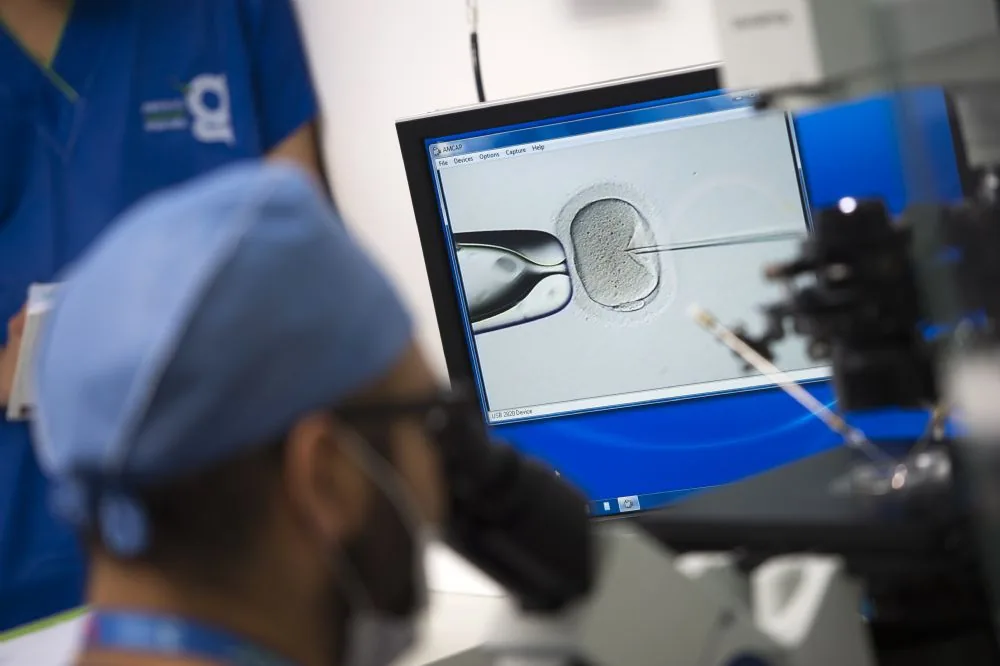
High Complexity treatments require active lab intervention for fertilization to happen. Instead of letting pregnancy occur inside the body, egg and sperm meet under a microscope, the embryologist controls every step, and the resulting embryos are transferred to the uterus when ready.
It is the right level when there is significant male factor, advanced reproductive age, endometriosis, low ovarian reserve, previous failures, or any diagnosis where natural fertilization in the lab would be unlikely.
At Ingenes we apply it inside a comprehensive plan, with the option to combine advanced techniques (PICSI, IVF MORE™, PGT-A, Ovagen™, Endogen™) and pair it with Multi-Cycle Programs to maximize cumulative success.
- +0 Years refining IVF
- Up to 0% Cumulative Multi-Cycle success
- #0 Success rate in LATAM
What defines a High Complexity treatment
-
The lab drives fertilization
Egg and sperm come together outside the body, under microscope. The embryologist decides which sperm is used and confirms fertilization before the next step.
-
Step-by-step biological control
Embryos are cultured under controlled conditions for 3 to 5 days. That lets us select the most viable, run genetic studies before transfer, and pick the ideal implantation moment.
-
Handles the hardest cases
It is the only path when male factor, age, or previous failures make natural lab fertilization unfeasible. It also allows combining techniques: regenerative medicine, genetics, donation.
Typical cases where High Complexity is the path
It is never the default choice. We arrive at High Complexity after a clear diagnosis, when clinical data shows that a low complexity treatment would have low chances of working.
Some typical profiles: couples with significant male factor (oligozoospermia, asthenozoospermia or teratozoospermia, high DNA fragmentation), women with low ovarian reserve, moderate or severe endometriosis, advanced reproductive age, previous insemination failures or failed cycles, female couples and single women who require IVF with donor sperm.
Your path is unique. So is your plan.
We design a protocol tailored to you after understanding your story and your previous tests. No generic diagnoses or protocols.
Which treatments are part of High Complexity
-
In Vitro Fertilization (IVF)
The High Complexity standard: ovarian stimulation, egg retrieval, lab fertilization, embryo culture, and transfer.
See IVF -
IVF with ICSI
Direct microinjection of one sperm into the egg. Indicated when there is male factor limiting spontaneous fertilization in the dish.
See ICSI -
IVF with PICSI
Biological sperm selection through hyaluronic acid. Adds another layer of precision over ICSI in complex cases.
See PICSI -
Multi-Cycle Programs
Between 2 and 4 cycles in the same plan with team review between attempts. Raises cumulative success up to 96%.
See Multi-Cycle -
Egg donation
When own eggs are not viable. Healthy, young, genetically screened donors. Very high quality results.
See Egg Donation -
Sperm donation
In-house bank and international donor bank with verified genetics, for female couples, single women, or severe male factor cases.
See Sperm Donation
What doing it with us changes
We have been performing High Complexity for over two decades. That experience translates into personalized protocols, an in-house lab, and a multidisciplinary team (reproductive physician, embryologist, geneticist, regenerative specialist, and metabolic specialist) that reviews every case.
We can add Ovagen™ and Endogen™ to regenerate ovarian or endometrial tissue, IVF MORE™ to restore eggs at the mitochondrial level, Procelk™ with exosomes, PGT-A and PGT-M to transfer only genetically fit embryos. All inside the TripleMed™ model.

Frequently asked questions about High Complexity
What is the difference between High and Low Complexity?
In Low Complexity, fertilization happens inside the woman's body (timed intercourse, artificial insemination). In High Complexity, fertilization is done in the lab and embryos are transferred already formed. The choice depends on the diagnosis, not on preference.
How long does a High Complexity cycle last?
Between 4 and 6 weeks: ovarian stimulation, egg retrieval, lab fertilization, 3 to 5 days of embryo culture, transfer, and two weeks of waiting until the blood pregnancy test.
How many attempts are usually needed?
It depends a lot on the case. For women under 35 without complicating factors, the first attempt has good chances. In complex cases, Multi-Cycle Programs allow planning 2 to 4 attempts with team review between each one, reaching cumulative success of up to 96%.
Can it be combined with regenerative medicine?
Yes. When the case requires it, we add Ovagen™, Endogen™, IVF MORE™ or Procelk™ to the IVF plan. These techniques improve egg quality, endometrial receptivity, or embryo quality. The decision is made at the First Consultation.
How do I know if High Complexity is right for me?
The diagnosis defines it, not the urgency. After the initial workup (semen analysis, hormonal profile, ultrasound, history), the team tells you which level of complexity offers the most real chances for your case. The First Consultation is the starting point.
Were you recommended a High Complexity treatment?
We help you understand which technique fits your case and what the full plan looks like. It starts at the First Consultation.
Contact us